
India's MBA landscape has undergone significant transformation in 2025-2026, with evolving entrance exam patterns, shifted specialization demand, and a clear divergence in return-on-investment (ROI) profiles.
Executive Summary
India's MBA landscape has undergone significant transformation in 2025-2026, with evolving entrance exam patterns, shifted specialization demand, and a clear divergence in return-on-investment (ROI) profiles. This comprehensive guide equips aspirants with data-driven insights into entrance exams, admission processes, top colleges, and emerging career trends to make informed decisions about their management education journey.
Part 1: MBA & Management Entrance Exams in India
The Indian MBA entrance exam ecosystem stratifies into three distinct tiers, each serving different college clusters and career trajectories.
Tier-1 Exams: Gateway to Premier Institutions
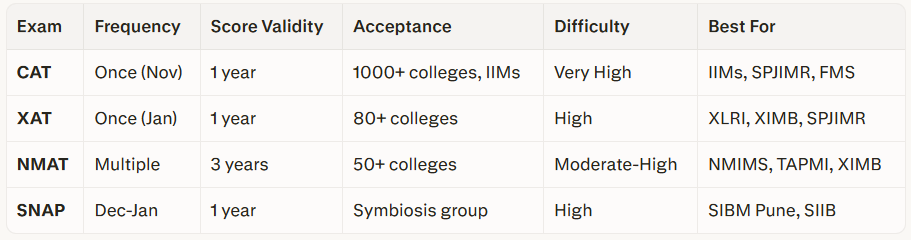
CAT (Common Admission Test) remains the gold standard, attracting 2.95 lakh aspirants annually. Administered by rotating IIMs, CAT's 2-hour format tests three sections: Verbal Ability & Reading Comprehension (VARC), Data Interpretation & Logical Reasoning (DILR), and Quantitative Aptitude (QA). For top IIMs like Ahmedabad, Bangalore, and Calcutta, General category candidates require a 99+ percentile overall with sectional cutoffs of 70-85. Sectional minimums are mandatory—a zero in any section disqualifies even high overall performers. The 2025 score-to-percentile correlation revealed that raw scores of 118-136 translates to 99+ percentile, while 70-75 raw marks suffices for 95+ percentile.
XAT (Xavier Aptitude Test) caters primarily to XLRI and allied institutions. The 95-question format emphasizes Decision Making alongside traditional sections. For XLRI's premium PGDM-BM program, a 96+ percentile is standard for men and 92+ for women. XAT 2025 data indicates 38.5 marks achieved 99 percentile, while 33 marks secured 95 percentile. XLRI graduates report median salaries of 29 LPA (2025), with historical averages of 32.7 LPA, positioning it as a direct competitor to top IIMs.
Comparison: CAT accepts 1000+ colleges; XAT serves 80+ institutions. CAT's monopoly on IIMs and premier institutions (SPJIMR, FMS Delhi) makes it the aspirant's primary choice. XAT's niche strength lies in decision-making emphasis, appealing to consulting and management-focused cohorts.
Tier-2 Exams: Flexibility & Parallel Pathways
NMAT (NMIMS Management Admission Test) now uniquely offers three-year score validity, permitting retakes without exam repetition. The overall NMAT cutoff ranges between 150-280, with NMIMS (historically the host) reducing its 2025 cutoff to 209. NMAT differs structurally: it tests Quantitative Skills, Logical Reasoning, and Language Skills across 120 questions in 120 minutes. However, NMIMS' 2025 admission overhaul reduced NMAT weightage from 60% to just 50%, introducing a proprietary "Competency Assessment" test—a critical shift signaling broader industry influence on admissions.
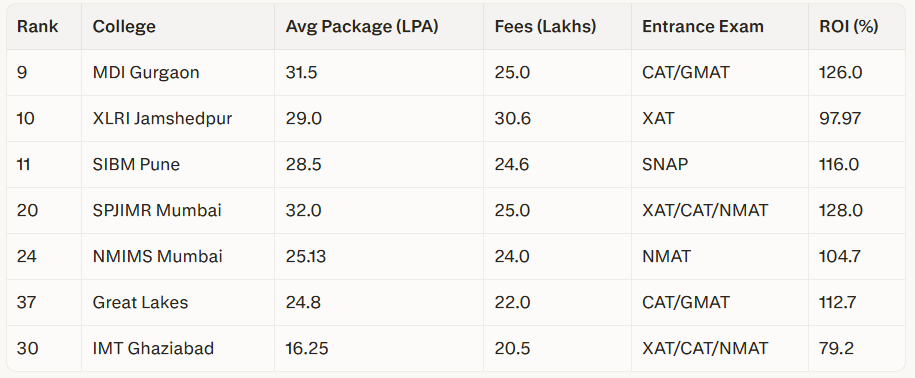
SNAP (Symbiosis National Aptitude Test) maintains Symbiosis group's reputation for interview-heavy selection. Scoring 35+ marks in SNAP 2025 nearly guarantees eligibility for top institutes; 30-35 marks permits mid-tier entry with strong interview performance. SIBM Pune (rank 11, NIRF 2025) maintains a 98-99 percentile cutoff, with average placements of 28.5 LPA and fees of 24.6 lakhs.
CMAT (Common Management Admission Test) conducted once annually by NTA in January accepts 600+ colleges. Difficulty levels remain moderate, with 85+ percentile securing calls from mid-tier institutions.
Tier-3 Exams: Volume & Accessibility
MAT (Management Aptitude Test) administered four times annually by AIMA serves 600+ colleges, particularly regional and emerging B-schools. Exam flexibility and lower difficulty attract diverse profiles but trade prestige for accessibility.
ATMA (AIMS Test for Management Admissions) offers 4-5 annual sittings with 180 MCQs spanning Analytical Reasoning (1 & 2), and Verbal Skills sections. With 740+ accepting colleges, ATMA provides maximum flexibility for serial test-takers managing multiple portfolios.
State-Level CET Exams: Maharashtra CET (MAH MBA CET), Tamil Nadu TANCET, Telangana TS ICET, and Andhra Pradesh AP ICET serve state-resident cohorts, offering lower fees but restricted geographic mobility.
Part 2: MBA Admission & Counselling Process: From Exam to Offer
Indian MBA admissions bifurcate into two parallel structures: centralized IIM selection and decentralized institutional processes.
IIM Selection: CAT → Shortlist → Composite Score → Final Selection
Step 1: CAT Cutoff & First Screening. Each IIM independently sets percentile thresholds. Top-tier IIMs (Ahmedabad, Bangalore, Calcutta) require 98-99 percentile for General category; newer IIMs (JAP: Raipur, Kashipur, Ranchi, Trichy) accept 90-95 percentile. Sectional cutoffs enforce minimum competency: candidates must score above zero in all three sections.
Step 2: Composite Score for Interview Shortlisting. Post-CAT, IIMs compute a composite score normalized across CAT performance, 10th/12th marks, and work experience. IIM Ahmedabad's formula exemplifies the variation: Composite Score = 0.50 × Normalized PI (anticipated) + 0.10 × Normalized AWT + 0.25 × Normalized CAT + 0.15 × Normalized Academics & Diversity. Notably, academic diversity (gender, social background) receives explicit weightage, favoring female candidates and first-generation professionals.
Step 3: Written Ability Test (WAT) & Personal Interview (PI). Shortlisted candidates undergo 30-minute WATs on business-relevant topics and 20-30 minute PIs assessing leadership, career clarity, and fit. IIM Ahmedabad weights PI at 50% of the final score—the highest among IIMs—emphasizing interpersonal caliber.
Step 4: Final Composite Score & Admission Offers. Final merit lists rank candidates by normalized composite scores. For IIM Ahmedabad (General category), expected composite score cutoffs for selection range 0.63-0.71. For IIM Calcutta, the formula differs: CAT receives 56% weight, while 10th/12th marks carry 10% and 15% respectively, with a 4% gender diversity bonus.
Common Admission Process (CAP) for New IIMs
IIM Bangalore, Delhi, Indore, Kozhikode, Lucknow, Mumbai, and Calcutta historically conduct independent selections. Newer IIMs (Raipur, Kashipur, Ranchi, Trichy, Udaipur) employ Joint Admission Process (JAP), a unified interview mechanism. JAP simplifies logistics: candidates attend a single centralized interview, yet each IIM applies its own composite formula, explaining why candidates receive offers from some JAP IIMs but not others.
Key Insight: Each IIM's weightage differs, meaning identical PI performances yield different final scores across institutions. Composite score formulas are published pre-admission, enabling candidates to strategically prioritize IIMs aligned with their academic strengths or work experience.
Non-IIM Admissions: SNAP, NMAT, XAT, and MAT Routes
Private institutions and government non-IIM colleges (FMS Delhi, JBIMS, TISS) implement parallel processes:
-
Exam Score Submission: Candidates apply directly to colleges with exam scores.
-
Shortlisting via Cutoff: Institutions set minimum score thresholds; exceeding them guarantees interview calls.
-
GD/PI/WAT Rounds: Group discussions, personal interviews, and written ability tests assess soft skills and domain knowledge.
-
Final Merit Calculation: Most colleges weight prior work experience (5-15%), academic record (10-20%), and interview performance (40-60%) alongside exam scores.
NMIMS' 2025 overhaul exemplifies evolving rigor: NMAT now contributes 50%, with a new NMAT Competency Assessment adding another 30% and AI-assisted PI adding 20%—shifting admissions toward continuous assessment rather than single-day exam reliance.
Part 3: Top Government MBA Colleges in India
The IIM Hierarchy: Tier-1, Tier-2, and New IIMs
Tier-1: Top-3 IIMs (IIM A, B, C)
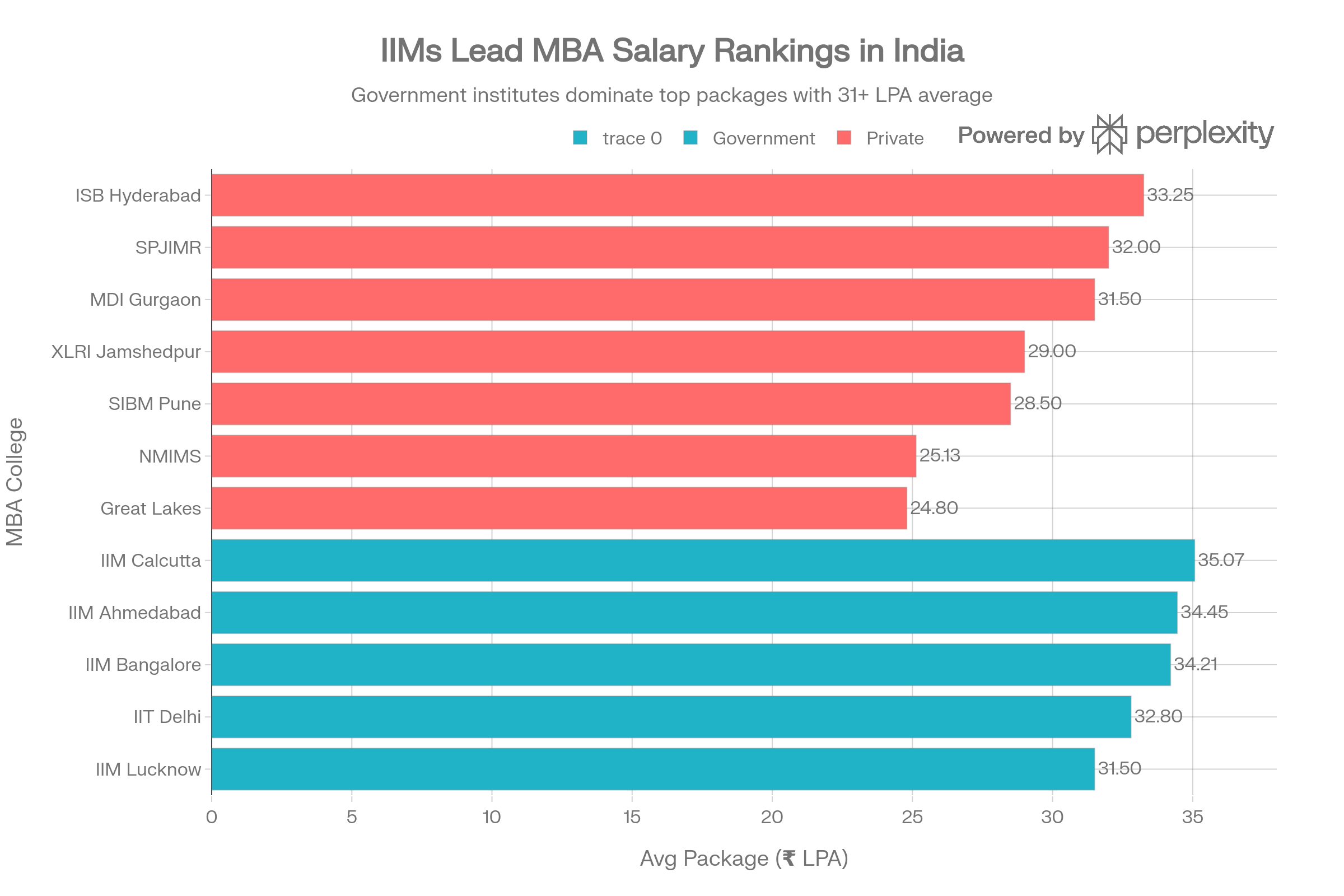
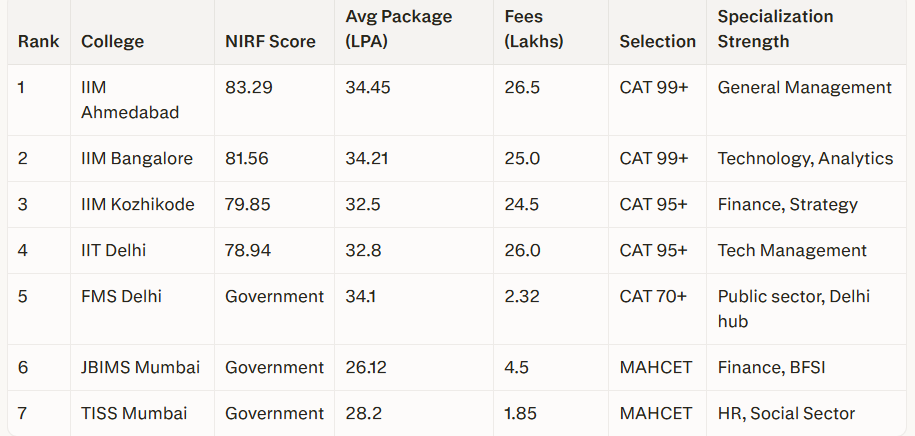
IIM Ahmedabad (Rank 1, NIRF Score 83.29) maintains its sixth consecutive top ranking with average packages of 34.45 LPA and fees of 26.5 lakhs. The 2025 median CTC stands at approximately 34 LPA, with 80% of graduates securing packages above 32 LPA. The institute's emphasis on PI weightage (50%) attracts candidates with leadership trajectories and industry impact.
IIM Bangalore (Rank 2, NIRF Score 81.56) averages 34.21 LPA with comparable fee structure and placement caliber. Its strengths lie in technology and analytics placements, with premium consulting firm dominance.
IIM Calcutta (Rank 7, NIRF Score 77.34) averages 35.07 LPA—surprisingly the highest among top-3 IIMs—owing to robust Kolkata financial sector recruitment. Fees at 27 lakhs position it slightly above peers.
Tier-2: Strong Mid-Tier IIMs (L, K, I, U)
IIM Lucknow (Rank 5, 77.97), IIM Kozhikode (Rank 3, 79.85), IIM Indore (Rank 8, 75.68), and IIM Udaipur maintain 90-95 percentile cutoffs with average packages of 31-32 LPA. These institutions offer superior ROI compared to Tier-1: lower CAT thresholds (95 vs. 99+ percentile) yield salaries only 2-3 LPA lower, creating compelling value propositions for tier-2 focused candidates.
New IIMs (JAP): Raipur, Kashipur, Ranchi, Trichy (Ranks 9-19)
With 85-92 percentile cutoffs and average packages of 25-27 LPA, newer IIMs serve candidates unable to breach 95+ percentile barriers. Payback periods extend to 10-15 months (vs. 10-11 months for tier-1), yet brand value appreciation and alumni network benefits justify premium positioning.
Beyond IIMs: FMS Delhi, JBIMS Mumbai, TISS, IIT Programs
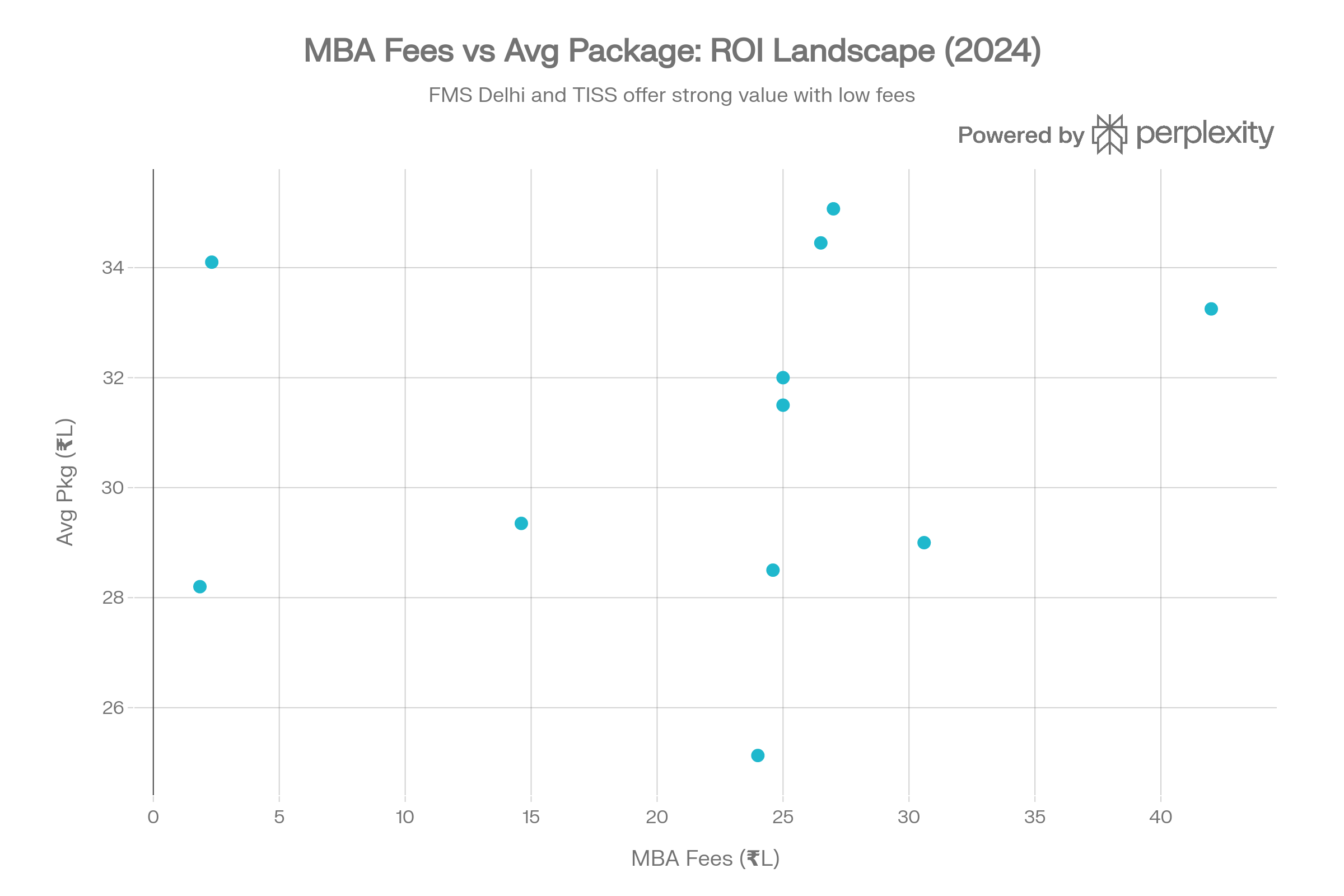
FMS Delhi (Faculty of Management Studies, University of Delhi) stands as India's highest-ROI institution. With fees of merely 2.32 lakhs and average placements of 34.1 LPA, FMS achieves a 1469.8% ROI with payback in approximately 25 days of post-MBA employment. Admission occurs via CAT with a 70+ percentile cutoff (considerably lower than IIMs), making FMS accessible to high-quality candidates unable to reach 90+ percentile thresholds. However, limited seats (approx. 120) and tier-1 city placement dominance concentrate opportunities among Delhi-NCR aspirants.
JBIMS Mumbai (Jamnalal Bajaj Institute of Management Studies) leverages Mumbai's financial hub proximity with MMS (2-year) and MSc Finance programs. MMS 2024 placements averaged 26.12 LPA with highest packages of 87.12 LPA, while MSc Finance 2025 averaged 18.3 LPA with highest of 28 LPA. BFSI and investment banking sectors recruited 28% of summer placements, indicating specialized finance strength. Fees remain affordable at 4-5 lakhs for both programs combined.
TISS Mumbai (Tata Institute of Social Sciences) offers subsidized MBA fees (1.85 lakhs for 2 years) targeting social sector focus. 2025 placements averaged 28.2 LPA with highest at 36.25 LPA. Specializations in Human Resource Management & Labour Relations distinguish TISS from IIMs, attracting candidates valuing social impact alongside financial returns.
IIT Delhi, IIT Bombay, IIT Kharagpur MBA Programs (Ranks 4, 14, 12) leverage IIT alumni networks and tech recruitment depth. IIT Bombay achieved 200.80% ROI—second only to FMS—due to 14.61 lakh fees and 29.35 LPA average packages. These institutions prioritize engineers and technical professionals, offering specialized programs in analytics and product management.
Part 4: Top Private MBA Colleges in India
Premium Tier: MDI, XLRI, SIBM, SPJIMR
MDI Gurgaon (NIRF Rank 9) ascended to India's top private college in 2025, displacing XLRI. Average placements stand at 31.5 LPA with 25 lakh fees, yielding 126% ROI. MDI's Gurgaon location and consulting firm penetration (McKinsey, BCG, Bain) drive premium corporate engagement. Admission via CAT/GMAT with 90+ percentile requirement.
XLRI Jamshedpur (NIRF Rank 10) maintains 29 LPA median salary (2025) with 30.6 lakh fees, registering 97.97% ROI. XAT cutoff of 96+ percentile restricts intake to elite performers. Dual PGDM programs (Business Management & Human Resource Management) differentiate XLRI, with HRM earning particular prestige in organizational development sectors.
SIBM Pune (NIRF Rank 11) reported 28.5 LPA average placements and 24.6 lakh fees via SNAP entrance. With 98-99 percentile SNAP cutoff requirements, SIBM attracts candidates equally positioned to IIM applicants but preferring SNAP's essay-focused selection over CAT's quantitative emphasis.
SPJIMR Mumbai (NIRF Rank 20) achieved 32 LPA average in 2025, down 3% from 2024's 33 LPA, attributed to reduced Fortune 500 recruiter participation. Accepts XAT, CAT, and NMAT with 93+ percentile cutoffs. Fee at 25 lakhs yields 128% ROI—competitive within tier-1 private cohort.
Tier-2 Private Institutions: NMIMS, Great Lakes, IMT, TAPMI
NMIMS Mumbai (NIRF Rank 24) underwent structural admission changes in 2025. Average placements fell to 25.13 LPA (MBA Core) from prior highs, with highest package at 67.70 LPA indicating top-tier placements counterbalanced by broader cohort underperformance. NMAT-based admission with 50% weightage (down from 60%) reflects institutional recalibration. At 24 lakh fees, NMIMS achieves 104.7% ROI despite moderate package trends.
Great Lakes Chennai & Gurgaon (NIRF Rank 37) position as value-oriented alternatives with 24.8 LPA average and 22 lakh fees, yielding 112.7% ROI. Specialization in analytics and data science appeals to candidates prioritizing quant-heavy domains.
IMT Ghaziabad (NIRF Rank 30) offers aggressive fee structures (20.5 lakhs) with 16.25 LPA average, serving tier-3 professionals and non-traditional backgrounds. Lower ROI (79%) compensated by placement diversity in manufacturing, logistics, and operations sectors.
TAPMI Manipal (NIRF Rank 39) accepts NMAT with mid-tier cutoffs, averaging 22 LPA and charging 20 lakh fees. Geographic advantage near tech hubs (Bengaluru) drives IT recruiter interest.
Specialized & International Options: ISB, XLRI Delhi, MICA
ISB Hyderabad (prestigious but unranked in management category) operates a distinctive one-year MBA model with 42 lakh fees and expected 2025 average packages of 35 LPA (conservatively estimated vs. historical 32.5-34 LPA). ISB's 80%+ cohort earning above 35 LPA demonstrates selectivity: the school targets experienced professionals (average 7+ years work experience) and international recruiting, with 80% of 2024 cohort receiving 35+ LPA packages globally. One-year format enables quicker ROI realization despite high absolute fees—approximately 15 months for payback.
XLRI Delhi-NCR operates as XLRI's satellite campus with comparable XAT cutoffs (92-99+ percentile) and slightly lower fees (27.4 lakhs) vs. Jamshedpur's 30.6 lakhs, maintaining 32.7 LPA average placements.
MICA Ahmedabad (NIRF Rank 33) specializes in media, marketing, and communications with 59.22 NIRF score and niche recruiting. Though lower general placement data, MICA dominates FMCG brand management and digital marketing sectors.
Part 5: CAT Percentile Cutoff Trends & College Tier Mapping
The 2025 CAT percentile ecosystem reveals tightening competition at elite tiers and bifurcated value propositions across bands.
99-99.99 Percentile: Top-3 IIMs (A, B, C). Securing seats requires not just overall 99+ percentile but sectional minimums of 70-85. Estimated average package: 34 LPA. Payback period: 10-11 months.
98-99 Percentile: Top IIMs + Strong Tier-1. Access extends to spots in Ahmedabad, Bangalore, Calcutta plus guaranteed Lucknow and Kozhikode. SPJIMR and FMS become realistic targets. Estimated average package: 33.5 LPA.
95-98 Percentile: Mid-Tier IIM Safe Zone. Candidates reliably secure IIM Lucknow, Kozhikode, Indore, and premium private colleges (XLRI via XAT, SIBM via SNAP). Estimated average package: 32 LPA. This band represents optimal effort-to-return calculus for many aspirants—achieving 95+ percentile requires focused 4-6 month preparation, yet 2-3 LPA salary differential from 99+ percentile is modest relative to marginal return diminishment.
90-95 Percentile: New IIM Gateway. New IIMs (Raipur, Kashipur, Ranchi, Trichy) become primary targets with 85-92 percentile thresholds. Private colleges like NMIMS, IMT, and Great Lakes open accessible entry. Estimated average package: 30 LPA.
80-90 Percentile: Non-IIM High-Quality Colleges. FMS Delhi, JBIMS, TISS, and tier-2 private institutions become realistic. Estimated average package: 25 LPA.
Below 80 Percentile: Emerging & Regional Colleges. Sector-specific specialists (manufacturing, healthcare, IT services) and state-level colleges become focal points.
Critical Insight: Incremental CAT percentile improvements yield disproportionately declining salary increments. Moving from 95 to 99 percentile (4-point gap) typically increases average package by 2-3 LPA (6-9% gain), while the effort multiplier increases substantially due to diminishing performance margins. Rational candidates should assess opportunity costs: pursuing 99+ percentile requires 6+ month preparation, whereas repositioning for 95+ percentile with early specialization focus (finance track, analytics, consulting) may deliver comparable career outcomes via non-IIM routes.
Part 6: MBA Admission Mistakes & Mitigation Strategies
Admission failures predominantly stem from application strategy errors rather than exam performance, as evidenced by high-quality candidates (97+ percentile) rejected from preferred institutions.
Critical Mistakes
Inconsistent Narrative. Admissions committees rapidly screen files, expecting resume, essays, recommendations, and interview to cohere into a coherent professional story. Candidates highlighting different strengths across materials (e.g., "operations excellence" in resume vs. "business development" in essays) trigger confusion and doubt regarding self-awareness. Mitigation: Identify 3-4 core professional messages; audit all application materials for alignment.
Authenticity Deficit. Aspirants often construct idealized profiles matching perceived committee preferences—sanitizing unconventional experiences, downplaying gaps, presenting overly polished narratives. Committees detect performance and prefer genuine professional motivations backed by lived experience. Mitigation: Emphasize actual experiences, decision-making rationale, and lessons learned rather than constructed trajectories.
Poor School Tailoring. Essays reusing competitor school names or regurgitating website facts betray insufficient engagement. Schools seek understanding of their distinctive program DNA and its relevance to your path. Mitigation: Attend campus events, interview alumni, research faculty research interests, and connect specific program elements (courses, teaching approaches, values) to substantive professional gaps.
Over-Claiming Company Prestige. Trading on brand-name company experience without demonstrating personal impact dilutes differentiation. Top schools see hundreds of Goldman Sachs alumni; distinguishing factors are individual contributions and learning. Mitigation: Emphasize specific projects, constraints overcome, stakeholders influenced, and operational improvements driven.
Wrong Recommenders. Selecting very senior leaders (partners, C-suite) who lack firsthand knowledge of work quality yields generic letters. Specific, detailed recommendations from direct managers outweigh seniority. Mitigation: Choose recommenders with direct observation of your performance; provide them with narrative context about key professional stories.
Weak Work-Life Integration. Admissions committees increasingly value professional-personal integration—how outside pursuits reflect leadership values, resilience, or intellectual curiosity. Disconnected "hobby" descriptions miss narrative leverage. Mitigation: Illustrate how non-work activities (volunteer leadership, competitive athletics, artistic pursuits) developed competencies relevant to MBA outcomes.
Part 7: MBA Specialization Trends & Future Demand
The 2025-2026 MBA employment landscape reveals AI-driven redefinition of traditional roles alongside explosive growth in analytics-adjacent specializations.
High-Demand Specializations
Business Analytics & Data Science tops demand rankings with 8.34+ LPA average salary and "Very High" placement momentum. Traditional financial modeling and operational analysis increasingly delegate to AI tools, elevating analytics professionals who guide strategy using AI insights. Competencies include SQL, Python, Tableau, and statistical reasoning. Top hiring sectors: fintech, e-commerce, consulting, healthcare.
AI & Machine Learning for Business (emerging distinct specialization) reports 9.0 LPA average with fastest-growing opportunity set. Roles like AI Strategy Consultant, AI Product Manager, and Chief AI Officer are nascent yet rapidly professionalizing. Salary premiums reflect scarcity: MBAs with prompt engineering, generative AI familiarity, and strategic AI implementation experience command 10-15% premiums vs. peers. Top sectors: tech, fintech, consulting.
Consulting & Strategy maintains 7.5 LPA average with "Very High" sustained demand. However, consulting is bifurcating: traditional business model consulting faces automation risk, while digital transformation consulting (AI implementation, cloud migration, data infrastructure) commands premium positioning. Consulting firms expanding AI advisory verticals actively recruit MBAs with tech literacy.
Finance & Fintech reports 5.52 LPA average—deceptively low due to base salary focus (bonus structures inflate actual compensation to 8-12 LPA). Investment banking, private equity, and fintech are recruiting heavily. However, entry-level analyst roles (historically MBA domain) are automating: AI algorithms execute financial modeling, valuation, and risk analysis. High-value MBA roles now concentrate in AI-augmented financial strategy, where human judgment interprets algorithmic outputs. Fintech hiring is resurgent: blockchain, neobanking, and lending platforms actively recruit MBAs.
Marketing (Digital, Analytics, Brand) sustains 6.5 LPA with "High" demand, particularly in e-commerce and FMCG sectors. Digital marketing merges with analytics: customer analytics, marketing attribution, personalization engines, and dynamic pricing require MBAs who translate AI outputs into customer strategy. Traditional brand management roles face demand contraction.
Supply Chain & Operations reports 6.0 LPA with "High & Resilient" demand. AI optimization of logistics networks, inventory management, and demand forecasting elevates operations-focused MBAs who can oversee automation deployment. Manufacturing, 3PL, and global supply chain firms actively hire.
HR Analytics & Talent Strategy emerges with 5.5+ LPA and "Growing" demand. People analytics, organizational network analysis, and AI-enabled talent acquisition/retention platforms create specialized roles. Tech and FMCG lead hiring.
Declining Specializations
General Management, Operations (non-analytics), and Traditional HR roles face relative contraction as companies prioritize technical literacy and data fluency. MBAs without quantitative capabilities or technology affinity encounter compressed compensation ranges.
Part 8: Cost-Benefit Analysis & ROI Across College Tiers
MBA economics have diverged sharply between government and private institutions, requiring nuanced ROI analysis.
Ultra-High ROI: FMS Delhi & TISS Mumbai
FMS Delhi's 2.32 lakh fee against 34.1 LPA average yields 1469.8% ROI, with payback in under 1 month of post-MBA income. TISS Mumbai similarly delivers 1524.3% ROI on 1.85 lakh fees and 28.2 LPA placements. Both institutions demonstrate that government subsidy enables extraordinary value propositions for candidates willing to navigate limited seat counts (120-150 total) and geographic constraints (Delhi and Mumbai hubs).
Trade-off: Severely restricted seat availability (0.1% admit rate) and tier-1 city campus locations (New Delhi, Mumbai) necessitate local network leverage or geographic relocation. Post-MBA mobility to Bangalore tech hubs or regional centers may involve commute or relocation costs not factored in fee calculations.
Premium ROI: Top-3 IIMs
IIM Ahmedabad delivers 100.88% ROI (34.45 LPA average ÷ 26.5 lakh fees), with payback in 10-11 months. IIM Calcutta yields 113.13% ROI. While lower percentage-wise than FMS, absolute salary increments (34+ LPA) translate to 5-7 lakh annual advantage vs. new IIM graduates (26-27 LPA), compounding to 20+ lakh lifetime value differential over 10-year careers.
Trade-off: Requires 99+ percentile CAT performance (top 0.1-0.5% nationally), demanding 6-8 month preparation and opportunity cost of deferred career entry.
Balanced ROI: Tier-2 IIMs & Premium Private Colleges
IIM Lucknow (31.5 LPA, 24 lakh fees) achieves 131.3% ROI with lower percentile threshold (95+). MDI Gurgaon (31.5 LPA, 25 lakh fees) yields 126% ROI via CAT/GMAT. SPJIMR (32 LPA, 25 lakh fees) delivers 128% ROI. These institutions optimize effort-to-return ratios: accessing 95-98 percentile requires 4-5 month preparation (vs. 7-8 months for 99+), yet salary penalties are modest (2-3 LPA vs. Tier-1).
Longer-Payback Premium Programs: ISB Hyderabad
ISB's 42 lakh fee and 33.25 LPA average generate 79.2% ROI—seemingly low. However, ISB's one-year format versus two-year MBA reduces opportunity cost by 1 year of deferred salary, shortening payback to ~15 months. Additionally, 80% of ISB 2024 cohort exceeded 35 LPA, indicating skewed distributions favoring experienced candidates (7+ years pre-MBA work experience). For career-pivots or executives, ISB's network and global brand justify premium despite percentage ROI compression.
10-Year NPV Analysis
Single-year ROI underweights long-term accumulation. Over 10 years:
-
FMS Delhi: INR 34.1 LPA × 10 years - INR 2.32 lakh = INR 3.408 crore (net gain post-fees)
-
IIM Ahmedabad: INR 34.45 LPA × 10 years - INR 26.5 lakh = INR 3.418 crore
-
Top 50 Private (NMIMS, SIBM): INR 26-28 LPA × 10 years - INR 24-25 lakh = INR 2.6-2.8 crore
Percentage ROI differences compress over time as salary compounding and career progression diminish initial fee variance importance. A candidate unable to exceed 90 percentile may rationally choose NMIMS (28 LPA, 24 lakh fees) over forcing marginal 95 percentile attempts.
Part 9: Future Trends in MBA Education & Careers (2025-2026 & Beyond)
AI Integration Reshaping Job Profiles
AI is not replacing MBAs; it is redefining MBA value propositions. Traditional MBA skills—financial modeling, market analysis, operational planning—are increasingly automated by tools like ChatGPT, Copilot, and specialized AI platforms. The MBA's new premium lies in strategic interpretation, innovation championing, and human leadership across AI-augmented teams.
New MBA Roles Emerging:
-
AI Strategy Consultant: Advising organizations on AI adoption, use-case identification, and change management—blending business acumen with technical fluency.
-
Generative AI Product Manager: Leading product strategy around LLM applications, prompt engineering, and responsible AI deployment.
-
AI Ethics & Compliance Officer: Navigating regulatory, fairness, and governance risks in AI systems.
-
Chief AI Officer / AI Director: C-suite roles emerging at scale (previously rare) as organizations professionalize AI governance.
All four roles command 10-15% salary premiums vs. traditional MBAs lacking AI literacy.
Data Literacy as Non-Negotiable
Business leaders no longer delegate data interpretation to specialists; they personally navigate dashboards, challenge algorithmic assumptions, and translate insights into strategy. MBA curricula increasingly embed Python, SQL, Tableau, and statistical reasoning as core rather than elective content. ISB, XLRI, MDI, and tier-1 private colleges have integrated AI courses across general management tracks rather than optional specializations.
Sector-Specific Trends
Consulting: McKinsey, BCG, and Bain are scaling AI advisory units; MBAs with AI + domain expertise (healthcare AI, manufacturing AI) are priority hires. Traditional strategy consulting faces compression; digital transformation consulting grows.
Finance: Entry-level analyst roles (historically MBA entry points) are automating. MBAs increasingly move to risk management, quant strategy, or AI-enabled portfolio roles, or transition to fintech (crypto, lending, neobanking). Average packages in finance remain stable, but role composition is shifting.
Technology: Tech MBAs face intensifying competition from computer science PhDs and bootcamp graduates. MBA differentiation now lies in product strategy, AI commercialization, and organizational scaling rather than technical coding capability.
Healthcare & Life Sciences: AI in diagnostics, drug discovery, and hospital operations creates demand for MBAs who combine clinical understanding with operational optimization.
MBA Program Evolution
Leading programs are restructuring curricula to embed AI alongside functional domains. ISB Hyderabad, IIM Bangalore, and XLRI now offer "AI for Strategy," "AI in Finance," and "Data-Driven Operations" as standard tracks. One-year executive MBA programs (ISB PGPX model) are proliferating, suggesting market preference for speed-to-ROI.
Micro-credentials and specialization certificates (6-12 week intensive modules) are fragmenting traditional full-time MBA monopoly. Candidates increasingly pursue MBA + AI Certificate + domain-specific bootcamp stacking—raising admission pressures on traditional 2-year programs.
Conclusion: Strategic Navigation for MBA Aspirants
The 2025-2026 MBA landscape rewards strategic navigation more than raw exam scores:
-
Calibrate Percentile Targets Rationally. Pursuing 99+ percentile for 2-3 LPA salary gain (over 95-98 percentile peers) is economically irrational unless IIM Ahmedabad's brand specifically aligns with career goals. Tier-2 IIMs and premium private colleges deliver stronger per-unit-effort returns.
-
Specialize Early. MBA admissions increasingly favor candidates with domain clarity. A finance professional with 95+ percentile secures better outcomes than a generalist with 98+ percentile at comparable-tier colleges.
-
Prioritize AI-Readiness. Whether aspiring to consulting, finance, technology, or operations roles, MBA careers post-2025 demand AI fluency. Colleges integrating AI across curricula (ISB, XLRI, MDI) deliver disproportionate placement advantages.
-
Account for Total Economics. ROI calculations must weight absolute salary gains, payback periods, opportunity costs, and 10-year NPV. FMS and TISS dominate percentage metrics; IIMs and premier private colleges dominate absolute wealth creation.
-
Craft Authentic Applications. Consistency, depth, and genuine career narratives outweigh exam perfection in final conversion. Investment in application quality (tailored essays, thoughtful recommenders, coached interviews) yields higher ROI than marginal percentile improvements.
The MBA remains India's highest-leverage credential for career acceleration, yet its efficacy increasingly correlates with intentional portfolio construction, AI-era specialization clarity, and authentic professional storytelling rather than exam percentile alone.