The Ivy League MBA has become synonymous with career acceleration and lifetime earning potential. Harvard Business School, Wharton, Columbia, Yale SOM, Cornell Johnson, and Dartmouth Tuck represent the gold standard in business education—not merely for their historical prestige, but for their unmatched combination of rigorous pedagogy, world-class faculty, and unparalleled alumni networks spanning finance, consulting, technology, and entrepreneurship.
I. Ivy League MBA Overview: Why These Programs Dominate Global Business Education
The Ivy League MBA has become synonymous with career acceleration and lifetime earning potential. Harvard Business School, Wharton, Columbia, Yale SOM, Cornell Johnson, and Dartmouth Tuck represent the gold standard in business education—not merely for their historical prestige, but for their unmatched combination of rigorous pedagogy, world-class faculty, and unparalleled alumni networks spanning finance, consulting, technology, and entrepreneurship. For international applicants in particular, these programs offer a transformative pathway to leadership roles at the world's most influential organizations.
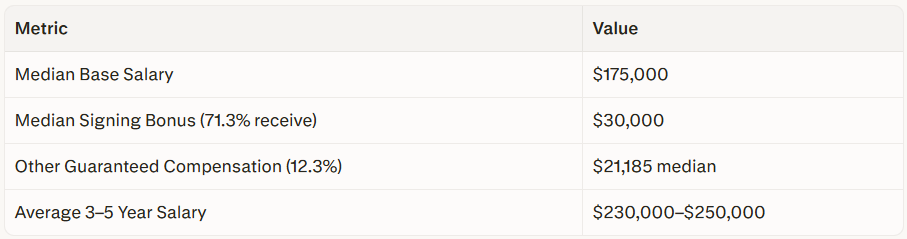
The economic case is compelling. Ivy League MBA graduates enjoy median starting salaries exceeding $175,000, with signing bonuses averaging $30,000 and comprehensive compensation packages that frequently exceed $200,000 in the first year. These figures exceed the U.S. average MBA salary by 50–60%, validating the premium investment. Beyond immediate compensation, the research reveals that Ivy MBA recipients achieve career trajectories placing them in C-suite, partnership, and entrepreneurial leadership roles within a decade—a outcome substantially more consistent than graduates from non-ranked or regional programs.
The selectivity barrier, however, has intensified. Harvard Business School now admits fewer than one in ten applicants. Wharton and Columbia similarly hover around 11–21%, making these programs more selective than leading undergraduate institutions. This exclusivity reflects not market scarcity, but rather institutional commitment to sculpting cohorts that combine exceptional academic credentials with demonstrated leadership and collaborative capacity.
For international applicants, the MBA has evolved from luxury to necessity. Global employers increasingly view the Ivy League MBA as a signal of not just technical competence, but cultural adaptability, network access, and the capacity to thrive in ambiguous, high-stakes environments. India, China, Southeast Asia, and Eastern Europe have emerged as primary international applicant pools, with strong applications from technology professionals, consulting analysts, and rising entrepreneurs seeking to pivot into general management.
II. Admission Requirements: Deconstructing the Selection Framework
Standardized Test Scores: GMAT, GRE, and the Shifting Landscape
The past three years have witnessed a fundamental realignment in how Ivy League MBAs evaluate standardized testing. While the GMAT remains the traditional gold standard, submission patterns are shifting. Across the top 10 business schools, GRE submissions now represent 37.2% of applications, up from 31.1% just two years ago. This trend reflects both expanded test-optional policies and applicant flexibility in choosing between assessments.
Competitive score ranges for Ivy League MBAs:
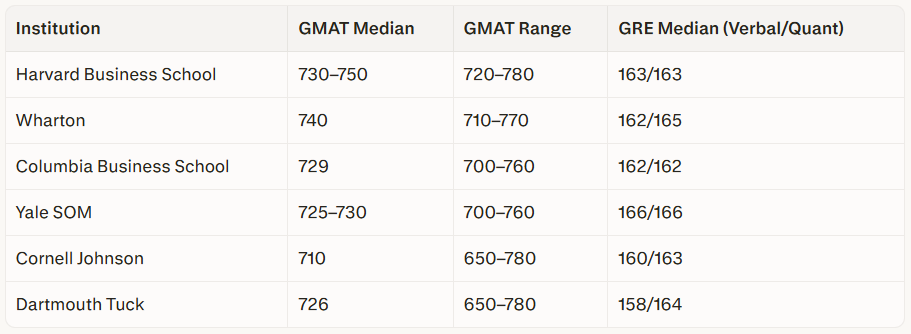
The critical insight: admissions committees no longer require GMAT over GRE, but they do expect strong performance on whichever test you submit. Schools such as Wharton, Yale, and Booth explicitly state they hold both tests to equivalent standards. However, only 5 schools to date report receiving more GRE than GMAT submissions, indicating the GMAT's continued prevalence.
For international applicants, particularly those from non-English speaking countries, the GRE's 5-year validity (versus GMAT's shorter window) and its acceptance across both MBA and MS programs creates strategic optionality. Yet the median GRE scores (162–166 per section) align with GMAT scores of 725–750, confirming that test choice does not lower the competitive bar.
Key trend: 75% of test-optional schools report that strong GMAT/GRE scores still provide a meaningful admissions edge. Even Harvard Business School, Stanford, Wharton, and Booth continue to require standardized tests, signaling that testing will remain central to admissions evaluation regardless of optional policies elsewhere.
Work Experience: Depth Over Years
The mythology around MBA work experience requirements often misleads applicants. Harvard, Wharton, and Columbia do not mandate minimum experience, yet their admitted classes average 5–6 years. This gap between minimum and average is critical: admissions committees evaluate work experience through a lens of professional maturity, demonstrated impact, and readiness for peer-based learning—not chronological tenure.
Experience expectations by cohort:
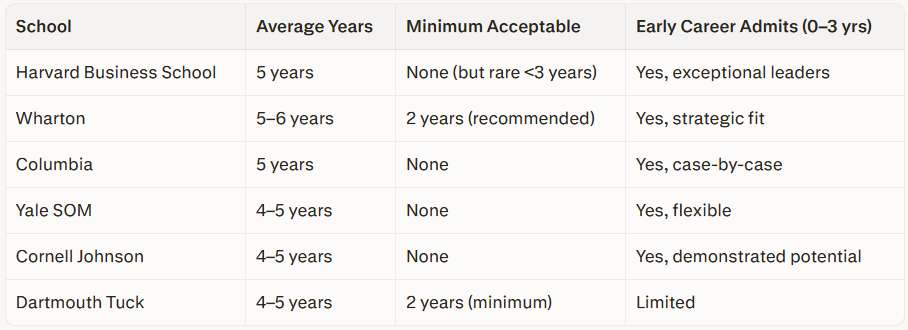
The admissions lens, as Wharton's admissions office clarifies, emphasizes "professional maturity" over tenure: the depth and breadth of your role, your contributions to the work environment, level of responsibility assumed, and trajectory of progression. A candidate with 3 years in a leadership-heavy role at a high-growth company (e.g., Series B startup founder, strategy manager at a scaling technology firm, or analyst-to-associate at a top investment bank) will often be more competitive than a candidate with 7 years in a static role.
This distinction matters enormously for international applicants. Visa sponsorship requirements often push candidates toward early-career application to secure a pathway before geopolitical or policy shifts further complicate immigration. Schools recognize this dynamic and evaluate international early-career candidates holistically, with particular attention to the quality of decision-making authority and cross-functional impact shown on resumes.
Leadership Profile Expectations: The "Smart, Nice, Accomplished, Aware" Framework
Tuck's explicit framework—seeking candidates who are "smart, nice, accomplished, and aware"—articulates a philosophy echoed across Ivy League admissions offices. This is not generic; it reflects fundamental shifts in what business schools value.
Smart extends beyond GMAT scores. Admissions committees seek intellectual curiosity, demonstrated problem-solving ability through career achievements, and the capacity for systems thinking. For international applicants, this often manifests in multilingual competency, cross-cultural project delivery, or technical expertise (especially in AI, data science, and emerging technologies) that signals intellectual adaptability.
Nice—increasingly articulated as "collaborative" or "community-oriented"—reflects schools' recognition that MBA cohort learning depends on mutual respect and willingness to contribute. Committees look for evidence of mentoring others, bridging silos across organizations, and driving inclusive processes. This has become strategically important as schools pursue diversity and inclusion: they seek leaders who actively facilitate diverse participation, not merely tolerate it.
Accomplished means quantifiable impact. This is where international applicants sometimes falter: vague descriptions of "increased efficiency" or "improved processes" are replaced in strong applications with metrics: "grew sales by 23% YoY," "led a cross-functional team of eight across three countries," or "reduced average resolution time from 12 to 4 days while maintaining 98% customer satisfaction." Admissions committees benchmark achievement against peer context—a high-performing manager at an emerging market consulting firm may show as strong or stronger impact than a junior analyst at McKinsey, depending on scope and outcome.
Aware signals self-awareness and growth mindset. Successful applicants articulate what they don't know, challenges they've faced, feedback they've internalized, and how they've evolved. This is where essays and interviews become critical: demonstrating that you can acknowledge failures without deflecting, learn from setbacks, and maintain perspective about your role within larger organizational systems.
Essays and Storytelling: Beyond Generic Narratives
MBA essays have shifted from demonstrating fit with a single institution to telling a coherent, differentiated narrative about who you are and what you'll become.
Current essay trends for 2025–2026 cycles:
1. Goals and "Why MBA" Essays have become dominant. These are no longer about describing career ambitions; they require applicants to articulate a specific gap between current capabilities and future aspirations, demonstrating how the MBA's particular resources—not just any MBA—bridge that gap. For example:
-
Weak: "I want to transition from technology to consulting because I want to develop leadership skills."
-
Strong: "As an engineering director at Stripe, I've built teams and shipped products, but I've never led P&L strategy across a portfolio. Columbia's core curriculum—particularly Cost Accounting and Corporate Finance—combined with the Consulting Club's case interview track and access to alums at BCG and Bain, will equip me to lead enterprise solutions strategy at a boutique consulting firm, a role where technical credibility plus business acumen command premium valuations."
2. Contribution Essays are increasingly popular. Schools ask applicants to describe how they'll enrich the MBA cohort—not through credentials, but through values, perspectives, and engagement. This is where diversity manifests not as a checkbox, but as authentic differentiation: a founder from rural India, an immigrant woman in tech leadership, a career-switcher from the military, or a sustainability practitioner from Southeast Asia each brings distinctive context that strengthens peer learning.
3. Authenticity Over Perfection has emerged as a meta-trend. Admissions officers have grown increasingly skilled at detecting AI-generated or consultant-polished essays that lack voice and vulnerability. The most compelling essays weave professional achievement with personal reflection: stories of cultural identity informing leadership approach, family background shaping ambitions, or moments of professional failure that fundamentally altered worldview.
Letters of Recommendation: Strategic Partnerships
Recommendations remain underestimated by applicants. Schools require two to three professional references—ideally direct supervisors—who can attest to work quality, team impact, and growth trajectory. The most effective recommendations move beyond praise to provide specific examples of leadership in ambiguous situations, resilience through setbacks, or intellectual rigor in complex problems.
Common mistakes in recommendations:
-
Choosing referees based on seniority rather than direct knowledge of your work
-
Providing insufficient guidance to referees about your MBA goals and narrative
-
Submitting generic recommendations indistinguishable from those submitted by dozens of peers
-
Failing to give referees advance notice of the submission deadline
Strategic best practice: Meet with referees in person (or via video if remote) to discuss your application narrative, MBA goals, and specific examples you'd like them to highlight. Provide a one-page summary of your career story and goals. This approach yields recommendations that are substantive, specific, and positioned within your broader narrative—a stark contrast to vague endorsements.
Interviews: Assessing Cultural Fit and Decision-Making
Most Ivy League MBAs employ one of two interview styles.
Behavioral Event Interviews (Harvard, MIT Sloan, Northwestern Kellogg) dive deeply into past experiences using the STAR method (Situation, Task, Action, Result). Expect probing follow-up questions that reveal not just what you did, but how you think. Common questions include:
-
"Tell me about a time you led a team toward a challenging goal."
-
"Describe a situation where you received critical feedback. How did you respond?"
-
"Give an example of when you influenced someone without formal authority."
-
"Tell me about a time you made a difficult decision with incomplete information."
The interviewer evaluates not just your achievement, but your thought process, values, and capacity for reflection. Strong responses dedicate roughly 60% of the narrative to the specific action you took, using "I" rather than "we" to isolate your individual contribution.
Conversational Interviews (Stanford, INSEAD, London Business School) resemble dynamic dialogue about your background, ambitions, and fit. These are less about testing with specific behavioral prompts and more about assessing whether you can articulate a coherent narrative, ask insightful questions, and engage thoughtfully with the interviewer's perspective.
For international applicants, interview accessibility has expanded: most Ivy League MBAs now conduct interviews via video, removing geographic barriers that previously favored proximity-based candidates. However, the leveled playing field means quality of preparation has intensified—you're competing against exceptionally prepared cohorts, not geographic convenience.
III. Acceptance Rates and Competitiveness: Strategic Context
Acceptance rate data alone misguides applicants. The headline figures—Harvard at 9.4%, Wharton at 11.8%, Yale at 27.3%—create an illusion of absolute selectivity, yet obscure crucial variation by applicant profile and application round.
Acceptance Rates by Institution (Latest Cycle):
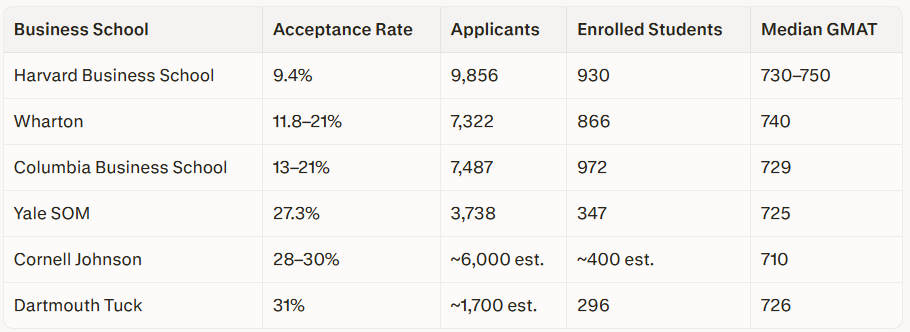
Important nuance: Reported acceptance rates often reflect final admitted candidates divided by total applicants, yet this masks substantial variation by round. Round 1 acceptance rates for top programs exceed Round 2 by 5–10 percentage points, and Round 3 sees further compression. For schools with over-represented applicant profiles (e.g., Indian males in technology, Chinese engineers), the effective acceptance rate in your segment may be 50–70% of the reported school-wide figure.
Yale's shift from 33% (Class of 2025) to 27.3% (Class of 2026) exemplifies the tightening dynamic: the school received 21.5% more applications while maintaining modest class size expansion, directly compressing acceptance. This pattern has repeated across the Ivy cohort, driven by three factors: (1) rebound from pandemic-era application dips, (2) global awareness of MBA ROI, and (3) increased volume from emerging markets (India, Southeast Asia, Brazil) where MBA aspirations have intensified.
IV. Cost, Financial Aid, and ROI: The Investment Case
The financial investment in an Ivy League MBA is substantial, yet the return on investment (ROI) is quantifiable and compelling for most career trajectories.
Total Program Costs (Two-Year Full-Time MBA, 2025–2026):
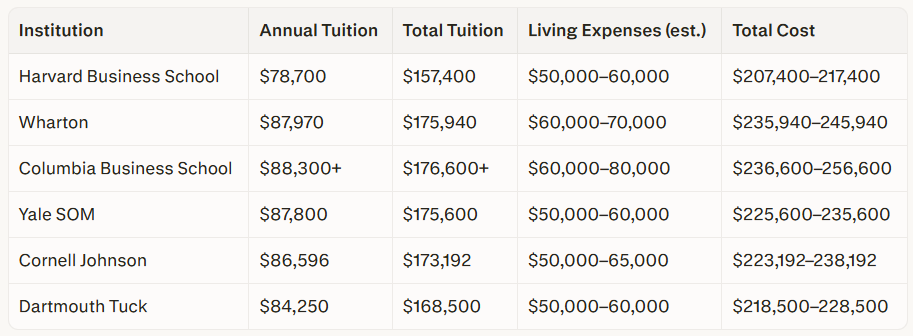
Additional costs include application fees ($250 per program), standardized testing ($250–500), visa and relocation expenses, health insurance, and books/materials ($2,000–3,000 annually). For international students, this often totals an additional $15,000–25,000.
Financial Aid and Scholarships
Contrary to popular belief, substantial financial aid is available at Ivy League MBAs, though merit-based awards often go to underrepresented applicant pools rather than distributed broadly.
Harvard Business School awards over $45 million annually in scholarships. Approximately 10% of the class receives full-tuition scholarships, while roughly 50% receive some form of need-based aid, with average awards around $42,000 annually ($84,000 over two years). The school's commitment to affordability stems from recognition that financial barriers disproportionately exclude talented applicants from lower-income backgrounds.
Wharton, Columbia, Yale, and Other Ivy Programs offer similar structures: merit-based scholarships (tied to exceptional GMAT/GPA/leadership), diversity-focused fellowships, and need-based aid for students demonstrating financial hardship. Many schools allocate a significant portion of scholarship funding in Round 1, making early application strategically advantageous not just for acceptance probability, but for financial aid access.
Types of awards:
-
Merit-based scholarships: Often cover 25–50% of tuition, awarded to applicants with top-tier credentials and leadership potential
-
Diversity fellowships: Supporting underrepresented minorities, women in business, veterans, and first-generation students
-
Need-based aid: Determined by FAFSA and demonstrated financial hardship; can exceed $60,000 annually
-
Corporate/alumni-funded scholarships: Often targeting specific industries (technology, finance) or geographies
International applicants should note: while most Ivy MBAs are "need-blind" for admissions (meaning citizenship doesn't factor into acceptance decisions), financial aid availability for international students is often more limited than for U.S. citizens and permanent residents.
Post-MBA Salary and ROI Analysis
The economic case for an Ivy League MBA is robust, though not universal across all career paths.
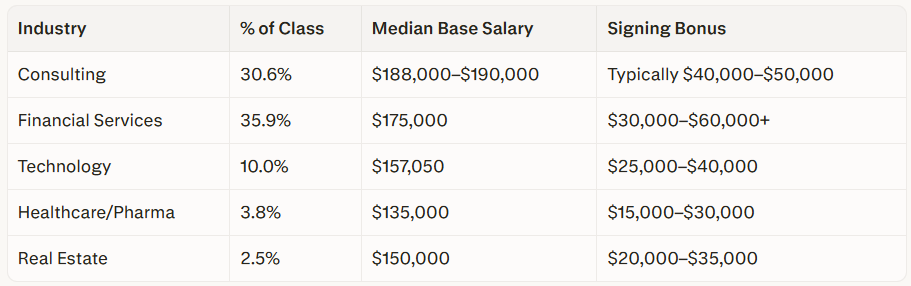
Columbia MBA Class of 2024 Employment Data:
By Industry (Columbia Class of 2024):
ROI Calculation:
Assuming a total MBA investment of $230,000 (tuition + living + opportunity cost of foregone salary during two years), and average starting salary of $175,000:
-
Year 1 salary advantage over pre-MBA baseline: $70,000–$100,000 (depending on pre-MBA role)
-
Three-year cumulative advantage: $250,000–$350,000
-
Break-even point: Typically 2–3 years post-MBA
-
10-year lifetime premium: $800,000–$1.2 million (conservative estimate)
This calculation assumes no career pivot or advancement acceleration—metrics that Ivy MBAs systematically outperform. More precisely, Ivy MBA graduates achieve C-suite, partnership, or entrepreneurial positions at substantially higher rates than peer cohorts without MBAs, a career trajectory advantage that compounds over decades.
For international applicants, the ROI calculation shifts depending on home country and return intentions. An Indian technology professional earning $80,000 USD (equivalent to ₹66 lakhs) who secures a $175,000 salary role in the U.S. post-MBA captures immediate value. Conversely, if returning to India, that MBA credential and network premium may translate to ₹2.5–3.5 crore compensation expectations over a decade—substantial but requiring patience and strategic network activation.
V. Application Strategy: Timing, Positioning, and International Considerations
Round Strategy: R1 vs. R2 vs. R3
The timing of application submission significantly influences acceptance probability, particularly for over-represented profiles.
Round 1 Advantages (typically September–November):
-
Higher acceptance rates: Schools have all available seats; no prior admits have claimed spots
-
Full scholarship budget: 100% of financial aid allocation remains available
-
Greater flexibility on scores: Admissions committees can admit strong R1 candidates and calibrate score profiles in later rounds
-
Cohort advantage: For over-represented profiles (e.g., Indian male technologist), R1 represents your strongest relative position before the pool saturates
Round 2 Advantages (typically November–January):
-
Refinement opportunity: Allows additional GMAT/GRE attempts, deeper program research, or strengthened essays
-
Meaningful improvement path: If your profile was borderline, R1 timing with a weak application is counterproductive; R2 with meaningful score improvement (50+ points GMAT) often yields better outcomes
-
Still competitive: Acceptance rates decline only 2–5 percentage points versus R1 at most programs
Round 3 Strategy (typically February–April):
-
Significantly compressed acceptance: R3 acceptance rates drop 10–25 percentage points below R1
-
Scholarship scarcity: Scholarship allocation is substantially depleted
-
Only apply if: Your profile is objectively stronger than R1/R2 (e.g., 40+ point GMAT improvement, major promotion, or new leadership achievement since R2 deadline)
Data-driven guidance:
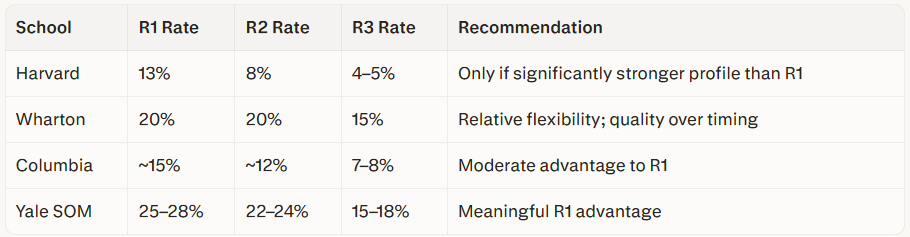
For international applicants, R1 timing is strategically critical. Visa and immigration policy remain unpredictable; securing MBA admission early provides optionality and reduces dependence on future policy stability. Additionally, U.S. work visa sponsorship (H-1B) for post-MBA roles is increasingly competitive; early graduation and early-hire recruiting windows provide maximum advantage.
Profile Positioning: The Over-Represented Applicant Problem
One of the most misunderstood dynamics in MBA admissions is the penalty for "over-representation." This term doesn't mean your profile lacks merit; it means your demographic and professional background is so common in the applicant pool that schools necessarily admit a smaller percentage.
Heavily over-represented profiles at Ivy League MBAs (2025–2026 cycle):
-
Indian male technology professionals (engineers, product managers, engineering managers) from mid-to-large tech firms (Microsoft, Google, Amazon, Infosys, HCL, TCS)
-
Chinese male finance professionals (investment banking, private equity) from mainland and Hong Kong
-
U.S. white male management consulting analysts from McKinsey, BCG, Bain
-
Indian female financial services professionals (investment banking, equity research)
For applicants in these segments, effective positioning involves two strategies:
1. Demonstrate Distinctive Impact: Instead of listing 30% revenue growth (common in your cohort), quantify your specific contribution. For example:
-
Weak: "Led a team of 8 engineers to deliver a mobile application that increased user engagement."
-
Strong: "Architected and personally led the go-to-market strategy for [specific product], increasing monetized user base from 2M to 8.5M (4.25x growth) within 18 months, driving $12M incremental annual recurring revenue and a $400M+ valuation premium."
The second version isolates your strategic thinking, stakeholder influence, and business acumen—differentiators in a pool of capable engineers.
2. Articulate Compelling Pivot: Schools admit from over-represented segments partly because you have clarity of purpose. Your MBA positioning should address: "What am I becoming that requires the MBA, and how is it differentiated from the 500 other Indian technologists applying?"
Examples:
-
From software engineer → "Building AI-driven solutions for enterprise efficiency requires understanding B2B sales motion, unit economics, and change management—gaps my engineering background doesn't address."
-
From management consultant → "Leading large-scale digital transformation at a late-stage company requires P&L accountability and sector expertise I can't develop in consulting."
-
From investment banker → "Transitioning to venture capital requires substantive technical knowledge (I'm pursuing the entrepreneurship track at [School]) and founder-mentorship competency beyond deal structuring."
International Applicant Strategy: Visa Dynamics and Strategic Considerations
The 2025–2026 cycle has witnessed meaningful shifts in international MBA applicant flows, largely driven by U.S. visa uncertainty and alternative options in Europe and Asia.
Key trends:
-
U.S. applications from international students have moderated: After historic highs in 2023–2024, some decline in international volume to top U.S. programs has been reported, offset partially by visa delays extending timelines
-
Europe and Asia MBA programs gaining momentum: Applicants increasingly consider INSEAD, HEC Paris, IESE, and Singapore-based programs as alternatives, partly due to fewer immigration barriers
-
India-specific pattern shift: While India remains the #1 source of international MBA applicants to U.S. schools, more Indian candidates are opting for Indian MBAs (ISB, IIM-A) due to affordability and career outcomes, particularly in technology and startups
Strategic guidance for international applicants:
1. Understand Visa Sponsorship Realities
U.S. work visas (H-1B, O-1) for MBA graduates remain competitive but viable. Ivy League MBA graduates, particularly in consulting and finance, are prioritized by employers for visa sponsorship. However:
-
Top consulting firms (McKinsey, BCG, Bain) and investment banks (Goldman Sachs, Morgan Stanley) actively sponsor visas for MBA hires
-
Technology companies increasingly hire MBAs on visa sponsorship, particularly for strategic roles
-
Startup sponsorship is less certain; ensure your post-MBA role aligns with employer categories regularly sponsoring visas
2. Timing and Deferred MBA Strategy
Deferred MBA programs (where you apply as an undergrad, work for 2–5 years, then enroll) have gained traction among international applicants as a risk mitigation strategy. Harvard's 2+2 program, MIT Sloan's deferred option, and Booth's deferred enrollment provide a secured MBA admission while you build early-career experience, gain visa sponsorship, and demonstrate clear career trajectory.
Deferred MBA advantages for international students:
-
Guaranteed MBA seat reduces post-graduation urgency to secure visa sponsorship
-
Early-career work experience on a work visa strengthens full-time MBA application
-
Additional time to strengthen GMAT score and professional positioning
-
Psychological security of knowing your MBA pathway is secured
3. Application Narrative for International Candidates
International applicants should explicitly address:
-
Why MBA now? If you're applying from home country, clarify geographic and industry context. Schools understand that an MBA from Harvard has different strategic weight in India versus the U.S.; acknowledge this.
-
Career intention clarity: Post-MBA, will you return home, remain in the U.S., or remain flexible? Schools value honesty. If you intend to return, frame the MBA as platform for industry leadership in your home market; if staying in U.S., emphasize long-term visa and career planning.
-
English language proficiency: Non-native speakers must submit TOEFL (minimum 100 iBT), IELTS (7.0 band), or Duolingo English Test (DET, 120) scores. Harvard, Wharton, and Columbia require minimum 100 iBT or equivalent. This is table-stakes; any score below minimum disqualifies.
VI. Common Mistakes in MBA Applications
Understanding and avoiding frequent pitfalls dramatically improves outcomes.
Mistake #1: Applying Too Early or Too Late
Too early: Candidates apply before they have substantive evidence of professional growth. Admissions committees need patterns, not potential. If you have under 2 years of work experience with limited evidence of leadership responsibility, decision-making authority, or impact, you're likely still forming professionally. Better to wait another year, gain promotion or expanded scope, and build a narrative of progression.
Too late: Conversely, applicants with 10+ years of experience or already-senior-level roles often misalign with full-time MBA cohorts, which typically skew toward young professionals. If you're a VP or C-level executive, an EMBA, executive MBA, or part-time program may be more aligned than intensive, full-time MBA designed for career acceleration, not C-suite continuation.
Solution: Benchmark yourself against the class profile. Is your level of responsibility, leadership scope, and progression aligned with admitted students? If yes, apply. If you're significantly junior (under 2 years) or senior (VP+), reconsider timing or program format.
Mistake #2: Underestimating GMAT/GRE Preparation
This is the most avoidable error with highest impact. Many candidates assume "good enough" scores—650–680 GMAT, 310–315 GRE—will compensate for other strengths. They won't. At competitive programs, median scores are 725–750 GMAT and 162–166 GRE per section. A 680 GMAT places you at roughly the 40th percentile; a 740 places you at the 95th percentile. This isn't marginal; it's disqualifying for most Ivy programs unless your profile has extraordinary offsetting strengths (Olympiad medalist, published researcher, etc.).
Best practice: Budget 3–6 months for GMAT/GRE preparation. Most successful applicants study for 100–150 hours. Use structured courses (Manhattan Prep, Target Test Prep, Magoosh) rather than self-study alone. Aim to complete your first full practice exam by month 1; your target score 3 months prior to application deadline. If you fall short, reschedule; never apply with a below-target score hoping essays will compensate.
Mistake #3: Generic or Rushed Essays
Admissions officers read thousands of essays. Generic narratives—"I want to become a CEO," "I want to lead a team," "I'm passionate about making a difference"—are immediately recognizable as template-derived or consultant-polished. Similarly, essays hastily written the night before deadlines lack coherence and voice.
Strong essays are specific, personal, and honest. They reveal distinctive career reasoning and genuine program fit.
Weak essay example:
"I am a software engineer at Google with a passion for business. I want to use my technical background to become a strategy consultant. Columbia's MBA will equip me with business knowledge, a prestigious brand, and a network of accomplished peers. The curriculum, career services, and alumni success in consulting make Columbia the ideal choice."
This fails because:
-
No distinctive insight about your journey or reasoning
-
Fails to differentiate Columbia from other programs (same language would work at Wharton, Harvard, or MIT)
-
Doesn't address why consulting specifically and why it matches your values/skills
-
No vulnerability or authentic voice
Strong essay example:
"Building distributed systems at Google taught me that technical excellence without understanding user economics is incomplete. I lead a project to reduce data-center costs by 15%, but realized I made trade-offs on feature velocity without truly understanding customer willingness-to-pay. That moment crystallized a gap: I can architect systems, but I can't architect strategy.
At my next role, I want to lead product strategy for an enterprise SaaS company—not just as a technologist, but as someone who understands go-to-market dynamics, pricing psychology, and organizational change. Columbia's consulting club projects, case course curriculum (especially Pricing Strategy), and connections to enterprise software partners (I'm targeting Salesforce, Workday, and Datadog alumni) will equip me to make that pivot. I'm drawn to Columbia's community of builders—engineers-turned-strategists who combine rigor with pragmatism."
Why this works:
-
Specific narrative of intellectual evolution
-
Clear gap analysis (what I have, what I need, why MBA closes it)
-
Substantive program fit (not generic praise but specific courses and resources)
-
Authentic voice revealing vulnerability and growth mindset
Mistake #4: Weak or Poorly-Guided Recommendations
Recommendations are opportunities to have a credible external voice vouch for strengths admissions officers can't directly verify. Yet many applicants treat recommendations as administrative obligations.
Common errors:
-
Choosing recommenders based on prestige rather than direct knowledge (CEO of the company, vs. your direct manager)
-
Providing insufficient guidance about what to highlight (don't just submit names and email; discuss your narrative, goals, and specific examples)
-
Generic recommendations indistinguishable from those written for dozens of applicants
Best practice: Meet with recommenders to discuss (1) your MBA narrative and goals, (2) specific examples of your leadership, teamwork, or problem-solving, and (3) schools to which you're applying. Provide a brief summary of your career story. Give them 2–3 weeks to write; reminders one week prior to deadline. Strong recommendations move beyond praise to provide specific, context-rich examples: "Sarah led our cross-functional redesign of the customer onboarding flow, reducing activation time from 45 to 8 days while improving NPS by 18 points. She navigated conflicting stakeholder interests with remarkable empathy, ensuring sales, engineering, and customer success felt heard."
Mistake #5: Inconsistencies, Typos, and Sloppy Execution
In a competitive pool, small errors signal carelessness and lack of seriousness. Common errors:
-
Resume and timeline inconsistencies (employment dates that don't align across documents)
-
Typos or grammatical errors in essays and cover letters
-
Submitting recommendations without confirming they've actually been submitted
-
Missing school-specific information in essays (submitting the same essay to multiple schools, or obviously copied language)
Solution: Proofread meticulously. Have a trusted editor review essays and your application package. Read your essays aloud to catch awkward phrasing. Verify all dates and timelines across resume, application, and essays are consistent. Submit a test application well before the deadline to confirm all materials upload correctly.
VII. Future Trends: The Evolving MBA Landscape
The MBA admissions ecosystem is shifting in ways that will reshape 2025–2026 and beyond.
Test-Optional Policies: Scores Still Matter
While over 50% of MBA programs adopted test-optional policies post-COVID, the landscape is nuanced. Most selective programs (Harvard, Wharton, Booth, Stanford) continue to require standardized tests. Among test-optional schools, 75% report that strong GMAT/GRE scores still provide a meaningful admissions edge. The practical implication: test-optional shouldn't be interpreted as "tests don't matter." Rather, it signals flexibility for candidates with offsetting strengths (e.g., published research, technical credentials like CFA, or exceptional professional achievement). For most applicants, a strong standardized test score remains a critical differentiator.
AI in MBA Admissions and Curriculum
Two concurrent trends are reshaping AI's role in MBA admissions:
1. AI-Enhanced Screening: Schools are deploying AI tools to assess application fit, essay coherence, and recommender authenticity. However, admissions officers emphasize that AI screens for patterns, not against candidates. A well-written, authentic essay will pass AI review; generic, consultant-polished essays are increasingly flagged.
2. AI Usage Questions: Harvard Business School and Wharton now explicitly ask applicants how they've used AI in their work or preparation. Schools are shifting from prohibiting AI to expecting candidates to demonstrate discernment in using AI as a collaborative tool rather than a replacement for thinking. The most compelling answers show candidates leveraging AI for ideation, research, and drafting—while maintaining critical oversight and authorship.
3. AI-Integrated Curriculum: Nearly 50% of MBA applicants consider AI knowledge essential. Programs are rapidly integrating AI into core curricula and offering specialized AI courses. For international applicants, particularly from India and China, demonstrating familiarity with AI applications in your industry strengthens positioning.
Diversity and Inclusion Evolution
The landscape of diversity at MBA programs is evolving beyond affirmative action debates toward a focus on substantive representation and inclusion. Schools are increasingly seeking candidates from underrepresented geographies (rural India, Sub-Saharan Africa, Southeast Asia) and underrepresented career paths (nonprofit leaders, military veterans, career-switchers from non-traditional backgrounds).
For international applicants, this opens opportunity. Your unique geographic or career context is itself a form of diversity. Rather than downplaying your background, emphasize how your perspective—shaped by a different market, regulatory environment, or cultural context—enriches the MBA cohort.
Deferred MBA Growth
The number of undergraduates securing deferred MBA admission has accelerated. Programs like Harvard 2+2, MIT Sloan's deferred option, and others provide a secured pathway for exceptional college students to pursue early-career experience before entering the MBA. This trend will likely continue, potentially reducing spots available for traditional post-work-experience applicants at some schools. Monitor your target schools' deferred enrollment volumes and adjust your application strategy accordingly.
International Program Growth
As noted earlier, applicants increasingly consider non-U.S. MBA programs—INSEAD, HEC Paris, IESE, Singapore's Nanyang Business School, and CEIBS—as viable alternatives or complements to U.S. programs. These programs offer compelling trade-offs: shorter durations (12–16 months vs. 24), diverse international cohorts, and European networks valuable for global careers. For international applicants with visa concerns or financial constraints, exploring global options strategically is wise.
Conclusion: Your MBA Application Strategy
Securing admission to an Ivy League MBA requires excellence across every dimension: competitive GMAT/GRE scores, substantive work experience demonstrating leadership and impact, compelling essays revealing authenticity and clear purpose, strong recommendations, and strategic application timing. For international applicants, the challenge is compounded by visa dynamics, geographic distance, and potential language barriers—yet these same factors can become differentiators if navigated strategically.
The admissions landscape in 2025–2026 remains intensely competitive, with acceptance rates at historic lows for top-tier programs. Yet thousands of accomplished professionals successfully navigate this process annually by avoiding common mistakes, positioning their distinctive strengths authentically, and maintaining clarity about why an MBA fits their specific career trajectory.
The Ivy League MBA remains unmatched in terms of recruiting prestige, alumni network depth, and career trajectory acceleration. For candidates meeting the academic and professional bar, the MBA continues to deliver exceptional return on investment. Apply strategically, authentically, and early. Your future self will thank you.
