
A complete guide for Undergraduate, Master’s, MBA, and PhD applicants. A sharply written college admissions resume (or academic CV) is often the second document an admissions reader looks at after your transcript or application form—and it can dramatically influence how they perceive everything else you submit.
A complete guide for Undergraduate, Master’s, MBA, and PhD applicants
A sharply written college admissions resume (or academic CV) is often the second document an admissions reader looks at after your transcript or application form—and it can dramatically influence how they perceive everything else you submit.
This guide synthesizes best practices from top universities (Ivy League, Oxford/Cambridge, M7 MBA programs, leading Russell Group schools) and career centers so you can build a resume/CV that works for Harvard and HEC, MIT and Imperial, Stanford GSB and LSE alike.
Part 1: Why Resumes Matter in Admissions
How admissions officers actually use your resume
-
Many elite universities explicitly ask for a CV/resume and treat it as a core supporting document for assessing experience, achievements, and fit.
-
Oxford, LSE, and UCL note that your CV is used alongside transcripts, statements, test scores, and references to judge academic preparation, experience, and potential contribution.
-
Top MBA programs such as Stanford GSB and Wharton expect a one‑page, impact‑focused business resume to summarize your professional trajectory, leadership, and results.
In practice, readers skim your college admissions resume in 30–60 seconds to answer questions like: “How strong is this profile relative to our average?” “Where have they shown leadership, initiative, and impact?” and “Does their experience support the story in their essays?”
Academic merit vs. profile presentation
-
Your transcript and test scores show what you have studied; your resume shows what you have done with it—research, competitions, leadership, internships, and impact.
-
Career centers at Harvard, MIT, and Cornell emphasize tailoring resumes/CVs to the specific opportunity and foregrounding the 3–4 most important strengths, not listing everything you’ve ever done.
-
Oxford and Cambridge-style CVs focus on evidence—concrete outputs like projects, publications, and grants—rather than vague responsibilities.
Common mistakes applicants make
Some of the most frequent reasons strong applicants weaken their college admissions resume:
-
Overloaded 3–4 page documents for undergraduate or MBA applications where 1 page is the norm.
-
Generic bullet points that list duties instead of achievements (e.g., “Responsible for…” with no outcome).
-
No quantification—no numbers, no scale, no evidence of impact.
-
Unclear structure and poor formatting that make it hard to skim quickly or parse in an ATS (Applicant Tracking System).
A winning resume for Ivy League admissions or Oxbridge applications makes your strengths obvious in seconds: clear headings, achievement‑oriented bullets, and quantified impact, all tailored to the program.
Part 2: Resume vs CV vs Bio‑Data
Definitions and purposes
Resume
-
A concise, 1–2 page summary of your most relevant education, experience, and skills, tailored to a specific academic program or role.
-
Commonly used in the US and many professional contexts worldwide; ideal for undergraduate, taught master’s, and MBA application resumes.
Curriculum Vitae (CV)
-
A more detailed “course of life” document, often 2–4+ pages, emphasizing academic history, research, teaching, publications, and scholarly achievements.
-
Standard for PhD applications, research‑heavy master’s programs, and faculty positions.
Bio‑Data
-
“Biographical data,” emphasizing personal details (age, marital status, religion, etc.), historically used in South Asia for government jobs, grants, or matrimonial purposes.
-
Not appropriate for most modern international university admissions, which generally do not want demographic details like age or religion.
Typical length and usage
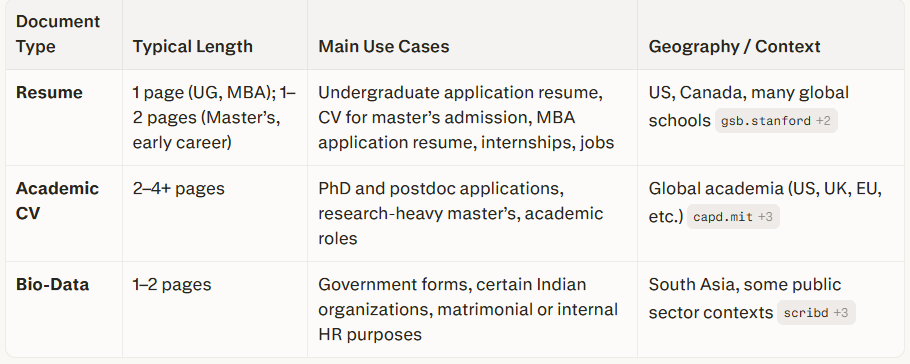
Admissions‑specific differences
-
US colleges and MBA programs usually expect a resume (with academic flavor) rather than a long CV, and explicitly recommend 1 page for undergraduates and MBA applicants.
-
UK and European universities use the term “CV” but often mean a 1–2 page hybrid: concise but slightly more detailed than a job resume, focusing on education, research, and relevant experience.
-
PhD and research‑heavy applicants should submit a full academic CV with structured sections on research, publications, conferences, and teaching.
For a study abroad resume, always follow the terminology and length guidance used by the target university; when in doubt, 1 page for undergraduate and MBA application resumes and 1–2 pages for taught master’s is a safe default.
Part 3: What Top Universities Look for in a CV
Across Ivy League, Russell Group, M7 MBA, and top STEM/PhD programs, admissions committees converge on several core dimensions.
Core evaluation dimensions
-
Academic excellence – Grades, course rigor, rankings, honors, standardized test scores where appropriate.
-
Leadership & initiative – Positions of responsibility, founding or scaling activities, leading teams or projects.
-
Impact and outcomes – Tangible, quantified results: improved performance, revenues, users, participation, or outcomes.
-
Intellectual curiosity & research ability – Research projects, publications, conference presentations, independent study, or advanced coursework.
-
Professional achievement – For master’s and MBA: career progression, promotions, complexity of roles, and sector impact.
-
Community engagement & global perspective – Volunteering, NGOs, cross‑cultural experiences, study abroad, international work or projects.
Differences by institution and program type
Ivy League & US selective universities (UG/Master’s)
-
Emphasize academic rigor, leadership, service, and “spike” achievements (deep excellence in one or two areas) on the college admissions resume.
-
Value breadth of activities but especially sustained commitment and impact over many years.
Russell Group & UK universities
-
CVs focus on academic performance, relevant courses, research, and evidence of suitability for the chosen subject.
-
Evidence of reading beyond the syllabus, research skills, and relevant work/volunteering is valued.
M7 MBA and top business schools (HBS, Wharton, Stanford GSB, Booth, Kellogg, Columbia, MIT Sloan, INSEAD, LBS)
-
Expect a one‑page MBA application resume that is accomplishment‑heavy, quant‑strong, and leadership‑rich.
-
Look for progression (promotions, increasing scope), people leadership, cross‑functional collaboration, and measurable business impact (revenues, costs, growth, efficiency).
STEM Master’s and PhDs
-
Focus heavily on research, technical projects, lab work, and quantitative rigor.
-
Publications, conferences, and strong technical skills sections are often decisive for top STEM and engineering programs.
PhD admissions
-
Evaluate research readiness: prior projects, methods, publications/preprints, conference talks, and alignment with faculty research.
-
Teaching or mentoring experience is a plus, especially in fields where PhD students teach undergraduates.
Part 4: Ideal CV Format for Undergraduate Applicants
Recommended structure (1‑page undergraduate application resume)
Sections (suggested order):
-
Header (Name, contact, city, email, phone, optional LinkedIn/portfolio).
-
Education
-
Academic Achievements & Competitions
-
Activities & Leadership (clubs, student government, NGOs)
-
Research & Projects (if any)
-
Community Service & Volunteering
-
Sports, Arts & Other Extracurriculars
-
Skills & Certifications
US career centers recommend a one‑page reverse‑chronological format for college students, focusing on education and most recent experiences.
Example bullet points (before vs. after)
Weak:
-
“Member of school robotics club.”
Strong:
-
“Led 5‑member robotics sub‑team to design and program autonomous line‑following robot; placed 2nd out of 40 teams in state‑level competition.”
Weak:
-
“Did community service at an NGO.”
Strong:
-
“Organized weekly tutoring sessions for 30 underprivileged students in math and science, improving average test scores by ~18% over 6 months.”
What to include
-
Education: School name, city, expected graduation, board/exam system, GPA/percentage, rank if strong (e.g., “Top 3 of 200 students”).
-
Academic achievements: Olympiads, NTSE, KVPY, AP/IB scores, school rank, national exams, subject prizes.
-
Competitions & projects: Robotics, coding contests, debates, MUNs, hackathons; briefly describe your role and outcome.
-
Leadership: House captain, club president, team captain, event organizer; focus on what you changed or grew (membership, funds raised, events organized).
-
Summer schools & internships: Include selective summer programs, research internships, or shadowing experiences with brief, quantified achievements.
-
Skills: Programming languages, foreign languages, tools (e.g., Python, Adobe, Excel), instruments, etc.
For a resume for Ivy League admissions, it is more powerful to show depth in 3–5 major activities with impact than to list 20 superficial ones.
Part 5: Ideal CV Format for Master’s Applicants
Recommended structure (1–2 page CV for Master’s admission)
-
Header
-
Education (Bachelor’s first; include GPA, key courses, thesis/project).
-
Academic Projects & Research
-
Internships & Work Experience
-
Publications & Conferences (if any)
-
Leadership & Extracurriculars
-
Skills (technical, languages, tools)
-
Awards & Scholarships
Graduate schools and career centers emphasize ordering sections to highlight strengths (e.g., education and research first for academic programs, work experience first for more professional degrees).
Example bullets
Project (Engineering Master’s applicant):
-
“Developed optimized scheduling algorithm for microgrid energy dispatch using mixed‑integer programming, reducing simulated operating costs by 12% compared to baseline.”
Internship (Policy/Economics applicant):
-
“Assisted policy research team by cleaning and analyzing panel data of 5,000+ households; co‑authored briefing note used in state budget discussions.”
Research (Data Science applicant):
-
“Implemented deep learning model to classify 50,000+ medical images with 91% accuracy, outperforming existing baseline by 7 percentage points.”
For a CV for master’s admission, ensure that each project shows your role, methods, and outcomes—not just the title.
Part 6: Ideal CV Format for MBA Applicants (M7 and other top programs)
One‑page MBA application resume structure
M7 schools, including Harvard Business School, Wharton, Booth, Kellogg, Columbia, Stanford GSB, and MIT Sloan, expect a one‑page resume for applicants with typical 3–8 years of experience.
Recommended sections:
-
Header (Name, contact, LinkedIn; no photo).
-
Professional Experience (reverse chronological; majority of the page)
-
Education (undergraduate + any postgraduate)
-
Leadership & Community / Extracurricular
-
Skills & Interests
Wharton and Stanford stress showing impact, progression, and team/leadership ability, not just job descriptions.
What M7 schools specifically look for on the resume
-
Clear career progression: promotions, expanded scope, and increasing responsibility.
-
Quantified achievements: revenue, cost savings, productivity, users, markets entered, deals closed.
-
Leadership: managing people, leading cross‑functional initiatives, driving change.
-
Global and cross‑cultural exposure: international projects, clients, or postings where possible.
-
Fit with post‑MBA goals: experiences that show readiness for targeted post‑MBA roles.
Example “before and after” bullets
Weak:
-
“Responsible for managing marketing campaigns.”
Strong:
-
“Led 6‑member marketing team to design and launch 3 digital campaigns that increased qualified leads by 38% and reduced acquisition cost by 22% in 9 months.”
Weak:
-
“Worked on financial modeling.”
Strong:
-
“Built LBO and DCF models for 5 potential acquisitions (deal sizes USD 50–200M), supporting 2 successful deals and identifying 1 target with projected IRR <10% that was subsequently dropped.”
Weak:
-
“Involved in product launch.”
Strong:
-
“Owned go‑to‑market plan for B2B SaaS product across 3 regions; coordinated sales, marketing, and customer success teams, achieving USD 1.2M ARR in first year vs. USD 800k target.”
A resume for M7 MBA programs must read like a track record of business impact, not a job description.
Part 7: Ideal CV Format for PhD Applicants
Academic CV structure (2–4+ pages)
PhD application guidelines from MIT, Cornell, UC Davis, Oxford, and PhD‑focused resources emphasize a detailed academic CV that showcases research potential.
Suggested sections:
-
Header
-
Research Interests (2–4 lines, tailored to program)
-
Education
-
Research Experience (projects, RAships, labs)
-
Publications (peer‑reviewed, preprints)
-
Conferences & Presentations
-
Teaching Experience (TA, tutoring)
-
Awards, Grants & Scholarships
-
Technical & Methodological Skills
-
Professional Experience (only if relevant)
-
Service & Leadership (committees, societies)
-
References (as requested)
Example bullets for PhD CV
Research experience:
-
“Undergraduate thesis: ‘Quantum Transport in 2D Materials’; designed and executed experiments using low‑temperature transport measurements; analyzed 10,000+ data points using Python and MATLAB.”
Publication:
-
“Doe, J., et al. (2025). ‘Graph Neural Networks for Traffic Forecasting.’ Proceedings of XYZ Conference, pp. 120–132.”
Conference presentation:
-
“Presented poster ‘Optimizing Reinforcement Learning for Portfolio Allocation’ at ABC Conference (2025), attracting 50+ attendees and shortlisted for Best Poster.”
Teaching:
-
“Teaching Assistant, Algorithms (3 semesters): led weekly problem‑solving sessions for 60 undergraduates; consistently rated 4.8/5 in student evaluations.”
For a graduate school CV or academic CV, completeness and clarity matter more than strict brevity, though many PhD guides still recommend aiming for 2–4 pages for early‑career applicants.
Part 8: CV Differences by Field of Study
Different disciplines expect different emphases on an academic CV or study abroad resume.
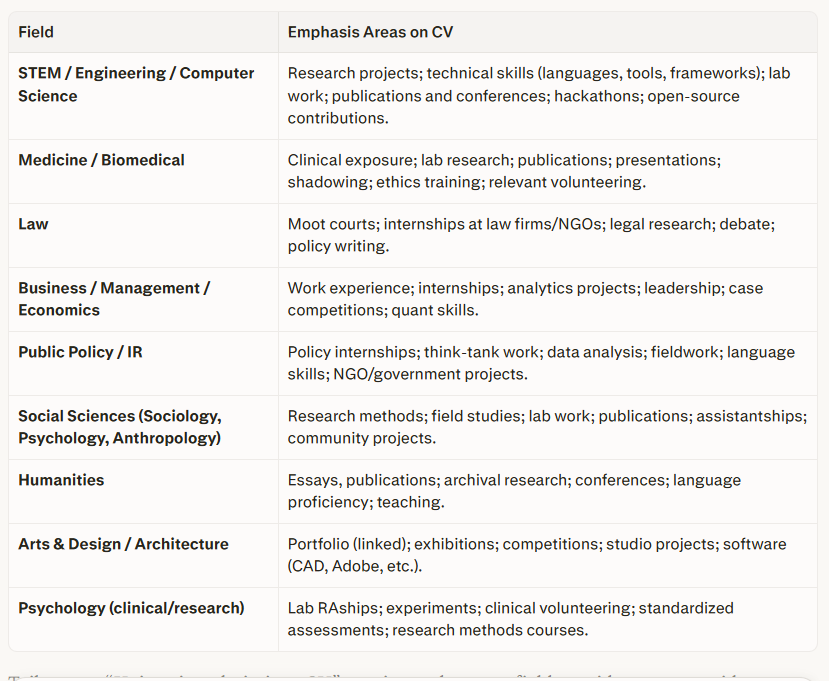
Tailor your “University admissions CV” to mirror what your field considers strong evidence: methods, tools, outputs, and context.
Part 9: How to Write High‑Impact Bullet Points
Principles of achievement‑focused writing
Career centers at Harvard, Stanford, UTD, and others all stress using action verbs, concrete detail, and outcomes.
A reliable pattern:
Action verb + what you did + how you did it + outcome/impact
Example:
“Designed and executed digital marketing campaigns that increased engagement by 45% across 50,000+ users.”
100 powerful action verbs (for college admissions resumes)
Accelerated, Achieved, Acquired, Activated, Adapted, Addressed, Advanced, Advised, Analyzed, Architected, Assembled, Audited, Automated, Built, Captained, Championed, Clarified, Coached, Collaborated, Consolidated, Constructed, Coordinated, Created, Cultivated, Delivered, Demonstrated, Designed, Developed, Directed, Discovered, Drove, Enabled, Engineered, Enhanced, Ensured, Established, Executed, Expanded, Facilitated, Formulated, Founded, Generated, Guided, Implemented, Improved, Increased, Influenced, Initiated, Innovated, Inspired, Integrated, Introduced, Led, Leveraged, Managed, Mentored, Mobilized, Negotiated, Optimized, Organized, Orchestrated, Oversaw, Pioneered, Planned, Presented, Produced, Programmed, Promoted, Redesigned, Reduced, Refined, Researched, Resolved, Revamped, Spearheaded, Standardized, Streamlined, Strengthened, Structured, Supervised, Supported, Tested, Trained, Transformed, Upgraded, Validated, Verified, Visualized, Volunteered, Won, Wrote.
Before‑and‑after examples
Academic project (weak vs. strong)
-
Weak: “Did final year project on renewable energy.”
-
Strong: “Designed solar‑powered water pumping system for rural village; reduced estimated fuel expenses by 60% and improved water availability for ~300 residents.”
Leadership (weak vs. strong)
-
Weak: “Head boy of school.”
-
Strong: “Elected Head Boy; led 20‑member council to implement peer‑mentoring program for 150 juniors, decreasing disciplinary incidents by 25% over one year.”
Research (weak vs. strong)
-
Weak: “Worked in a neuroscience lab.”
-
Strong: “Conducted EEG data collection and processing for 40‑participant attention study; co‑authored manuscript submitted to peer‑reviewed journal.”
MBA‑level experience (weak vs. strong)
-
Weak: “Worked on cost reduction.”
-
Strong: “Led cross‑functional initiative that renegotiated vendor contracts and redesigned processes, reducing logistics cost by 18% (USD 400k annually).”
Part 10: Quantification of Achievements
Why numbers matter
Oxford Careers, Harvard, USC, and ATS guidelines all highlight quantification as a key way to demonstrate scale and impact, not just activity.
Admissions readers can compare “increased club membership by 80%” across candidates; they cannot meaningfully compare “helped grow club.”
How committees interpret metrics
-
Scale: Size of team, users, budget, audience.
-
Change: Percentage improvements (scores, revenues, participation, efficiency).
-
Selectivity: Acceptance rates, rankings, competition scale.
-
Frequency: “Weekly,” “daily,” “over 3 years” shows consistency and commitment.
Dozens of quantification examples
Academics
-
“Scored 97 percentile in national engineering entrance exam (top 3,000 of 100,000+ candidates).”
-
“Ranked 2nd of 120 students in BSc Computer Science cohort.”
-
“Completed 5 advanced mathematics courses (GPA 9.5/10) including Real Analysis and Probability.”
Research
-
“Processed and analyzed 1.2M+ transaction records using Python and SQL for master’s thesis on consumer behavior.”
-
“Co‑authored 2 peer‑reviewed papers (1 first‑author) and 1 conference abstract.”
Leadership & clubs
-
“Grew entrepreneurship club membership from 18 to 55 students within one year through targeted outreach and monthly workshops.”
-
“Secured INR 1.5 lakh sponsorship for annual college fest, a 3x increase over prior year.”
Internships
-
“Automated monthly reporting process, reducing preparation time from 8 hours to 45 minutes per report.”
-
“Supported sales team by qualifying 200+ leads, contributing to 15 closed deals (INR 40 lakh total revenue).”
Entrepreneurship
-
“Launched mobile game that reached 10,000+ downloads and 4.6/5 rating within 3 months.”
-
“Bootstrapped e‑commerce store to INR 3 lakh monthly revenue in 9 months with 30% net margin.”
Sports
-
“Represented school football team as captain; led team to district semifinals for first time in 5 years.”
-
“Won 3 medals (1 gold, 2 silver) at state‑level swimming championships.”
Volunteer work & NGOs
-
“Coordinated weekly food distribution for ~120 homeless individuals, managing 25 volunteers.”
-
“Designed awareness campaign that reached 8,000+ people across social media and schools.”
Clubs & competitions
-
“Participated in 6 national‑level hackathons; placed top‑5 in 2 events (out of 200+ teams each).”
-
“Prepared case study submission selected among top 10 of 250+ entries at international business competition.”
Your resume for Oxford and Cambridge, for M7 MBA programs, or for top STEM master’s abroad should be packed with such quantified, context‑rich bullets wherever possible.
Part 11: Research Projects, Publications & Internships
How to present research projects
Follow academic CV guidance: include title, institution, supervisor, methods, and outcomes.
Example format
Undergraduate Research Assistant, Department of Physics, XYZ University
Month Year – Month Year
-
“Simulated graphene nanoribbon electronic properties using tight‑binding models; wrote Python scripts to compute band structures.”
-
“Presented preliminary results in departmental seminar (audience ~40).”
Publications & conferences
MIT and UC Davis recommend grouping publications and presentations with full citations and bolding your name.
Example
Publications
-
Doe, J., YourLastName, A., & Smith, B. (2025). “Title.” Journal Name, 12(3), 45–60.
Conferences
-
“Title of Talk,” Conference Name, City, Year (oral presentation).
Internships & capstone projects
Cornell and other graduate career centers suggest describing the goal, your contributions, and the impact.
Example
Data Analytics Intern, ABC Consulting
-
“Cleaned and merged 10+ datasets (500k+ rows) for retail client; built dashboards in Power BI used by senior leadership for weekly reviews.”
Part 12: Awards, Scholarships & Honours
How to present awards
-
Group into “Awards & Scholarships” or “Honours,” typically near education.
-
Include level (school, university, state, national, international) and selectivity.
Examples
-
“Recipient, National Talent Search Examination (NTSE) Scholarship (top 0.5% of applicants nationwide).”
-
“Dean’s List (top 10% of class), 4 semesters.”
-
“Winner, University‑wide Business Plan Competition (1st of 80 teams).”
Prioritize higher‑level and more recent awards; school‑level awards can be summarized if you have many.
Part 13: Leadership & Extracurriculars
Top universities explicitly value leadership, teamwork, and community engagement.
Areas to highlight
-
Student government: positions, initiatives, policy changes, or events organized.
-
NGOs & volunteering: sustained involvement, scale of beneficiaries, roles in program design.
-
Sports & arts: captaincies, performances, competitions, hours of practice, consistent participation.
-
Entrepreneurship: clubs, ventures, social enterprises; impact on customers or community.
Demonstrating impact
Instead of “Member, cultural committee,” write:
-
“Directed annual cultural festival with 2,500+ attendees; managed 15‑member organizing team and INR 3 lakh budget.”
Instead of “Volunteer teacher,” write:
-
“Designed 12‑week English curriculum and taught 20 rural students, improving average exam scores from 42% to 68%.”
Part 14: Design, Formatting & Visual Presentation
Length recommendations
Guidance from Stanford GSB, Wharton, USC, MIT, Oxford, and others supports the following lengths:
-
Undergraduate application resume: 1 page.
-
Master’s CV/resume: 1–2 pages.
-
MBA application resume (M7 and similar): 1 page (unless 10+ years experience and school allows 2).
-
PhD academic CV: 2–4+ pages depending on research output.
Fonts, margins, spacing
Career centers and ATS guidelines advise:
-
Fonts: Calibri, Arial, Times New Roman, or similar; 10–12 pt body, slightly larger headings.
-
Margins: 1 inch preferred; 0.75 inch acceptable if content is dense but still readable.
-
Layout: Single column, left‑aligned content, consistent spacing and bullet style.
-
White space: Enough margin and line spacing to scan easily—no wall of text.
ATS‑friendly choices
Even for university admissions, uploaded resumes may pass through ATS‑like systems.
-
Avoid tables, multi‑column templates, heavy graphics, and text boxes.
-
Do not place key contact information in Word headers or footers.
-
Use plain bullets (- or −), simple section headings (“Education,” “Experience,” “Skills”).
-
Save as PDF unless the school asks for Word; ensure PDF is text‑based, not a scanned image.
File naming conventions
LSE and other universities ask for clearly labeled documents.
Use: FirstName_LastName_CV_ProgramName_Year.pdf (e.g., Aarav_Sharma_Resume_MIT_MEng_2026.pdf).
Part 15: Common Mistakes That Get Resumes Rejected
At least 25 mistakes to avoid:
-
Typos, grammar errors, inconsistent tense.
-
Using paragraphs instead of concise bullet points.
-
Listing responsibilities with no outcomes or numbers.
-
Ignoring page length guidelines (e.g., 2–3 pages for an MBA resume when school wants 1).
-
Overloading with every activity ever instead of curating relevance.
-
Including personal details like age, religion, marital status, or photo where not requested.
-
Using fancy templates with multiple columns, graphics, or colored backgrounds that break ATS or look unprofessional for academic contexts.
-
Putting contact info in the header/footer (some systems don’t read it).
-
Using tiny font sizes to squeeze content instead of editing ruthlessly.
-
Mixing fonts, bullet styles, and inconsistent formatting.
-
Using first‑person pronouns (“I,” “we”).
-
Writing vague claims (“excellent leadership skills”) without evidence.
-
Not tailoring content to the program (e.g., tech‑heavy for policy degree or vice versa).
-
Copying job descriptions instead of describing what you achieved.
-
Inflating or misrepresenting achievements—this can be fatal if discovered.
-
Using university or employer jargon that external readers won’t understand.
-
Not translating non‑standard grading systems or ranks for international readers.
-
Including irrelevant hobbies or very early schooling.
-
Leaving unexplained gaps in education or work.
-
Using generic objectives (“To work in a challenging environment…”) instead of a concise profile or nothing.
-
Over‑emphasizing minor certifications and short courses over degrees and core experience.
-
Listing soft skills (teamwork, communication) as a separate bullet list instead of demonstrating them in experience bullets.
-
Ignoring instructions from the specific university (length, format, required sections).
-
Uploading outdated versions after updating elsewhere (LSE explicitly warns against this).
-
Submitting different stories across application form, CV, and LinkedIn (inconsistency raises red flags).
Part 16: AI Tools for CV Improvement (Ethical Use)
Several AI tools can help polish your college admissions resume if used thoughtfully:
-
ChatGPT / Perplexity: Can help rewrite bullets to be more concise, action‑oriented, and impact‑focused, and suggest section structures based on target programs.
-
Grammarly: Detects grammar, spelling, and tone issues—useful for non‑native English speakers.
-
Resume Worded / similar resume scanners: Provide feedback on bullet strength, quantification, and ATS‑friendliness.
-
LinkedIn tools: Profile strength meters and AI suggestions can inspire better summaries and experiences.
Ethical guidelines
-
Do not fabricate internships, research, or achievements; AI should only help with articulation and structure.
-
Double‑check all AI‑generated wording for accuracy and honesty; you are responsible for what you submit.
-
Tailor final content yourself; admissions offices expect authentic voice and coherence across essays, CV, and interviews.
Part 17: Sample Templates (with Example Content)
Below are simple text templates you can adapt. Adjust section order and content to fit your profile and target program.
A. Undergraduate Application Resume Template (1 page)
Header
Full Name
City, Country · Email · Phone · LinkedIn / Portfolio
Education
School Name, City, Country
Expected Graduation: Month Year
-
Board/Exam System (e.g., CBSE, IB); Current average: X% / GPA: X.X/4.0
-
Relevant coursework: [Course 1], [Course 2], [Course 3]
Achievements & Competitions
-
National Science Olympiad – State Rank 15 (top 0.5%).
-
School Topper in Grade 11 (1st of 180 students).
Activities & Leadership
-
President, Coding Club – “Expanded membership from 10 to 45 students; organized 3 hackathons with 200+ total participants.”
-
Captain, Debate Team – “Led team to 2 state‑level championships; mentored 6 junior debaters.”
Projects
-
“Developed Android app to track study habits; 500+ downloads and 4.5/5 rating on Play Store.”
Community Service
-
“Volunteered 120+ hours teaching math and English to 25 underprivileged students through local NGO.”
Skills
-
Programming: Python, Java, HTML/CSS
-
Languages: English (Fluent), Hindi (Native)
B. Master’s CV Template (1–2 pages)
Header
Education
University Name – Degree, Major, City, Country
Month Year – Month Year
-
GPA: X.X/4.0 (Top X%).
-
Thesis: “Title” (Supervisor: Prof. Name).
Academic Projects & Research
-
“Built predictive model for credit default using logistic regression on 50,000‑record dataset; improved baseline accuracy by 9 percentage points.”
Internships & Work Experience
Data Analyst Intern, Company Name, City
-
“Created dashboards in Tableau for 3 business units, used weekly by senior manager group.”
Publications & Conferences (if any)
Leadership & Activities
Skills
-
Technical: [List]
-
Languages: [List]
C. MBA Resume Template (1 page)
Header
Professional Experience
Company, Location – Role
Month Year – Present
-
“Managed team of 8 sales associates across 3 regions; delivered 22% YoY revenue growth (USD 5.4M → 6.6M).”
-
“Launched new pricing strategy that increased gross margin by 4 percentage points.”
Previous Role, Company
-
“Promoted from Analyst to Senior Associate within 18 months (18 months ahead of cohort average).”
Education
University, Degree, Major
-
GPA (if strong); key awards.
Leadership & Community
-
“Volunteer Mentor, NGO – guided 4 first‑generation college students through university application process; 3 admitted to public universities.”
Skills & Interests
-
Skills: [e.g., Financial Modeling, SQL, Power BI]
-
Interests: [1–3 specific items]
D. PhD Academic CV Template (2–4 pages)
Header
Research Interests
Short paragraph (2–3 lines) tailored to program.
Education
Include thesis titles, supervisors, GPA, key courses.
Research Experience
-
“Graduate Research Assistant, Lab Name – ‘Investigated X using Y methods…’”
Publications
Conferences & Presentations
Teaching Experience
Awards & Grants
Technical Skills
Professional Experience (if relevant)
Service & Leadership
References
(Names, titles, institutions, contact details as requested.)
Part 18: The 50‑Point Resume Review Checklist (Before You Submit)
Use this checklist just before submitting your college admissions resume or academic CV:
-
Correct document type (resume vs academic CV) for your target program.
-
Length matches guidelines (1 page UG/MBA; 1–2 pages Master’s; 2–4+ pages PhD).
-
File format is PDF (unless school asks otherwise).
-
File name is clear (
Name_Resume_Program_Year). -
Font is professional (Calibri/Arial/Times) and 10–12 pt.
-
Margins at least 0.75–1 inch.
-
Single‑column layout; no tables or text boxes.
-
No photos or personal demographic details unless explicitly requested.
-
Contact info (name, email, phone, city, LinkedIn) at top, not in header/footer.
-
Email address looks professional.
-
All spelling and grammar checked (run Grammarly or similar).
-
Tenses consistent: current roles in present tense, past roles in past tense.
-
No first‑person pronouns (“I,” “we”).
-
Section headings are clear and conventional (Education, Experience, etc.).
-
Education section includes institution, degree, location, dates.
-
Grades/GPA presented clearly and comparable where possible.
-
Key courses listed only when relevant to program.
-
Awards and honors listed with level and selectivity.
-
Experience bullets begin with strong action verbs.
-
Each bullet describes what you did and what happened as a result.
-
Most bullets include numbers (%, $, #, time) where reasonable.
-
Duplicate or overlapping bullets removed.
-
Older or less relevant experiences summarized or removed.
-
Leadership roles and initiatives clearly visible.
-
Community/volunteer work included where meaningful.
-
Research projects described with methods and outcomes.
-
Publications and conferences cited properly.
-
Skills section focuses on concrete technical/language skills.
-
Soft skills demonstrated through examples, not listed generically.
-
Activities show sustained commitment, not one‑off participation.
-
No unexplained long gaps in education or work.
-
Dates are formatted consistently (Month Year – Month Year).
-
For MBA resumes, work experience dominates page; education below.
-
For PhD CVs, research and publications are central sections.
-
Content is tailored to the specific program/field (keywords, emphasis).
-
No irrelevant personal hobbies crowding out more important content.
-
No sensitive data like ID numbers, full address, or parents’ details.
-
Hyperlinks (LinkedIn, portfolio, GitHub) are up to date.
-
Quantitative and analytical abilities are visible for business/STEM programs.
-
Cross‑cultural or global experiences highlighted (where relevant).
-
Any institutional instructions (page limits, required sections) strictly followed.
-
Version control: this is the final version referenced in your application system.
-
CV/resume claims are consistent with application form and essays.
-
A trusted mentor/teacher/manager has reviewed it.
-
Formatting looks clean when printed and on screen.
-
There is a clear “headline” impression in 10 seconds (e.g., “top student and Olympiad medalist,” “high‑impact product manager”).
-
The most important 3–5 achievements appear on the top half of the first page.
-
No dense blocks of text; white space is adequate.
-
You could comfortably defend every item in an interview.
-
You feel the document honestly and confidently represents your best self for this specific program.
Part 19: Expert Tips from a Former Admissions Committee Perspective
Here are 20 insider tips drawn from university and MBA‑admissions guidance plus career‑center best practices:
-
Think like a reader under time pressure. Assume 30–60 seconds for the first scan—design so your biggest strengths are unmissable in that window.
-
Lead with your spike. If you’re a researcher, put research early; if you’re a seasoned professional, lead with work experience; if you’re a top student, let academics shine first.
-
Mirror the program’s language. Use keywords from program pages and course descriptions (within reason) to signal fit.
-
Use context for non‑obvious achievements. Briefly explain local awards or lesser‑known institutions to help international readers evaluate them.
-
Show trajectory, not just snapshots. Highlight how responsibilities, scale, or results grew over time in your roles.
-
Treat each bullet as “evidence in a case.” Every line should prove something about your readiness for the program or your future goals.
-
For MBA resumes, focus on outcomes, not tasks. Admissions officers already know what a consultant or engineer does—show what you uniquely achieved.
-
For PhDs, emphasize methods and independence. Detail techniques, tools, and moments where you took initiative in research design or analysis.
-
For undergraduates, depth beats breadth. It’s better to show multi‑year leadership and growth in 3–4 areas than to list 20 clubs.
-
Clarify non‑traditional paths. If you took a gap year or changed careers, let your CV show intentional choices and learning, not randomness.
-
Be global‑friendly. Avoid local acronyms and unexplained abbreviations; spell out organization names and qualifications.
-
Quant skills matter more than you think. For business, economics, and many social sciences, show evidence of comfort with numbers (courses, projects, metrics).
-
Align with your essays and goals. If you say you want to work in climate tech but there is zero related activity, consider adding or highlighting relevant experiences.
-
Don’t hide “small” but relevant experiences. A short, unpaid internship at a policy think‑tank can matter more for an MPP application than a longer, unrelated role.
-
Use a “master CV” and tailor. Maintain a long master document; create shorter, targeted versions for specific universities and degrees.
-
Respect regional norms. A “Cambridge‑style” CV is more text‑first and academically focused; a US college admissions resume often emphasizes concise bullets and leadership.
-
Avoid gimmicks. Infographics, colorful timelines, or photos might work in creative job searches, but they usually hurt in academic and MBA admissions.
-
Prepare for interviews from your CV. Admissions interviewers often pick questions directly from your bullet points—be ready to tell the story behind each.
-
Update iteratively. Each application round is feedback; refine your resume based on what gets positive interviewer reactions or scholarship results.
-
Remember the resume is a bridge, not a biography. Its purpose is to get you to the next step—an interview, a deeper review, or a scholarship shortlist, where you can tell the rest of your story.
Conclusion and Key Takeaways
A winning college admissions resume or academic CV is not about how much you’ve done—it is about how clearly you show evidence of potential, impact, and fit for the specific program.
If you:
-
Choose the right format (resume vs CV),
-
Follow global best practices from leading universities and MBA programs,
-
Use action‑oriented, quantified bullet points aligned with your target field, and
-
Rigorously review your document with a checklist and ethical use of AI tools,
you can create a study abroad resume or university admissions CV that works just as well for Ivy League colleges as for Oxford and Cambridge, M7 MBA programs, and top PhD departments worldwide.
At Alwize Edu, an article like this should serve as a flagship resource: something applicants and parents can return to repeatedly as they refine their resumes for Ivy League admissions, resumes for M7 MBA programs, or academic CVs for competitive master’s and PhD programs abroad.