
The Ivy League comprises eight institutions—Harvard, Yale, Princeton, Columbia, University of Pennsylvania, Brown, Dartmouth, and Cornell—that collectively define the apex of global higher education.
I. What Makes Ivy League Universities Unique: Beyond Rankings
The Ivy League comprises eight institutions—Harvard, Yale, Princeton, Columbia, University of Pennsylvania, Brown, Dartmouth, and Cornell—that collectively define the apex of global higher education. Yet their prestige extends far beyond historical name recognition or endowment size. These universities represent a distinct educational philosophy: the integration of world-leading research, liberal arts education rooted in critical thinking, and an unwavering commitment to merit-based admissions that identifies exceptional talent regardless of geographic origin or socioeconomic background.
Holistic Admissions Philosophy
Ivy League institutions fundamentally differ from many global universities in their approach to admissions. Rather than reducing applicants to a single metric—standardized test score, GPA, or numerical ranking—Ivies employ "holistic review," evaluating each student as a complete person within their specific context. An admissions officer reviewing an application from rural India, a boarding school in Kenya, and a suburban U.S. high school asks not: "Who has the highest test score?" but rather: "Who has maximized the opportunities available to them and demonstrated initiative in pursuing intellectual challenges?"
This context-aware evaluation is transformative. It explains why Ivy League classes include international students and domestic students from vastly different economic backgrounds: the admissions process explicitly accounts for the educational resources, mentorship, and opportunities available in each applicant's environment. A student in a tier-2 Indian city who founded a debate club, taught underprivileged students, and achieved top marks in a limited resource setting may be viewed as demonstrating more initiative than a student at an elite prep school who participated in pre-packaged programs.
Research Excellence and Global Impact
Ivy League universities are research powerhouses. Harvard alone hosts over 9,000 research projects annually across its schools and institutes. Yale's graduate programs consistently rank among the world's best. Princeton's engineering programs drive innovation in AI, quantum computing, and renewable energy. For graduate students and postdoctoral researchers, an Ivy League affiliation opens doors to cutting-edge laboratories, world-class faculty mentorship, and resources that few institutions globally can match.
For undergraduate students, this research intensity translates into opportunities: the ability to conduct independent research alongside faculty, access to specialized facilities, and exposure to the intellectual frontiers of their chosen fields—advantages that prove invaluable in graduate school applications and early career positioning.
Global Employer Recognition and Alumni Networks
The Ivy League MBA commands premium salaries; the Ivy League PhD secures postdoctoral positions at leading research institutions; the Ivy League undergraduate gains preferential consideration from consulting firms, investment banks, and technology companies. This isn't solely due to historical brand equity. Rather, Ivy League graduates statistically demonstrate higher productivity, innovation, and leadership across industries. A recruiter hiring from Harvard or Stanford knows the institution's admissions process has already filtered for not just academic capability but adaptability, resilience, and the capacity to thrive in ambiguous environments—skills that directly translate to professional success.
For international students, this network advantage compounds. Alumni networks span continents: Indian Ivy League graduates serve as executives at TCS, Infosys, and Indian startups; Chinese graduates populate technology leadership roles in Beijing, Shanghai, and Shenzhen; Southeast Asian alumni lead multinational firms and government agencies. Admission to an Ivy League institution provides lifelong access to a global professional community, a network asset that extends far beyond a four-year or two-year degree.
II. Undergraduate Admissions: The Holistic Review Process
Acceptance Rates and Competitiveness: Understanding the Numbers
The headline acceptance rates for Ivy League undergraduate programs have reached historic lows. Harvard admits 3.19% of applicants; Yale 4.47%; Columbia 3.7–4.0%; Princeton 4.0%; and Cornell 8–9%. These figures require careful interpretation: they are not measures of absolute difficulty, but rather reflect the extreme imbalance between supply (roughly 50,000+ applications per institution) and demand (roughly 1,500–2,000 admitted spots per school).
Critical nuance: Early Decision and Early Action acceptance rates substantially exceed Regular Decision rates. Yale's Early Action rate stands at 10.98%, nearly triple the Regular Decision rate. Columbia's Early Decision rate reaches 14%, nearly four times the Regular Decision rate. This disparity reflects two dynamics: (1) Early applicants tend to be more committed and strategically positioned, and (2) schools fill 40–55% of their class through early rounds, leaving substantially fewer spots for Regular Decision applicants.
Ivy League Undergraduate Acceptance Rates (Class of 2029):
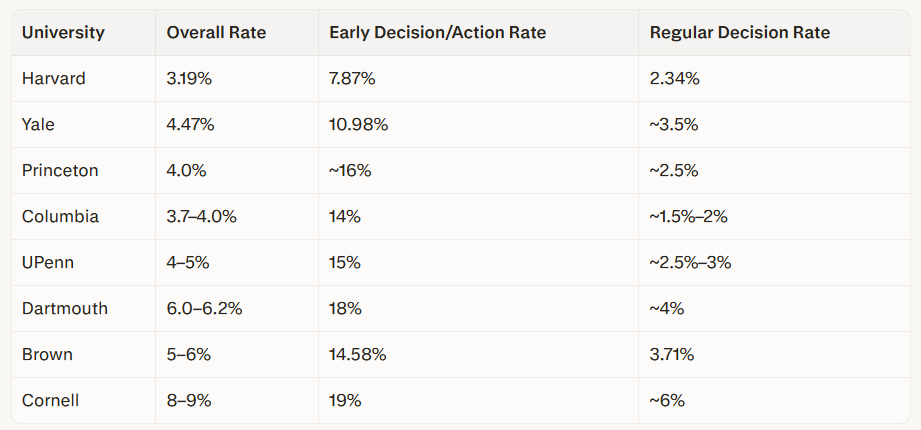
For international applicants, these rates carry additional weight. While most Ivies are "need-blind" for admissions (meaning citizenship doesn't factor into acceptance decisions), international applicants still compete in a global pool. India, China, Canada, and the United Kingdom are among the largest sources of Ivy applications; acceptance rates within these countries are typically 50–70% of the overall school rate, reflecting the strength of candidate pools from these regions.
Test-Optional vs. Test-Required: The 2025–2026 Landscape
The post-pandemic test-optional wave has substantially reversed. Harvard, Yale, Brown, Dartmouth, and UPenn have all returned to requiring standardized tests for Fall 2025 entry. Only Columbia (permanently test-optional) and Princeton (test-optional through 2026) among the Ivies maintain test-optional policies. Yale has adopted a "test-flexible" policy, accepting SAT, ACT, AP, or IB scores to satisfy the requirement.
This shift has critical implications for international applicants: Test-optional does not mean "tests don't matter." Rather, it reflects schools' recognition that not all students have equal test access. For international students, submitting a strong standardized test score—particularly in environments with limited testing infrastructure—can provide meaningful differentiation.
Expected score ranges for competitive applications:
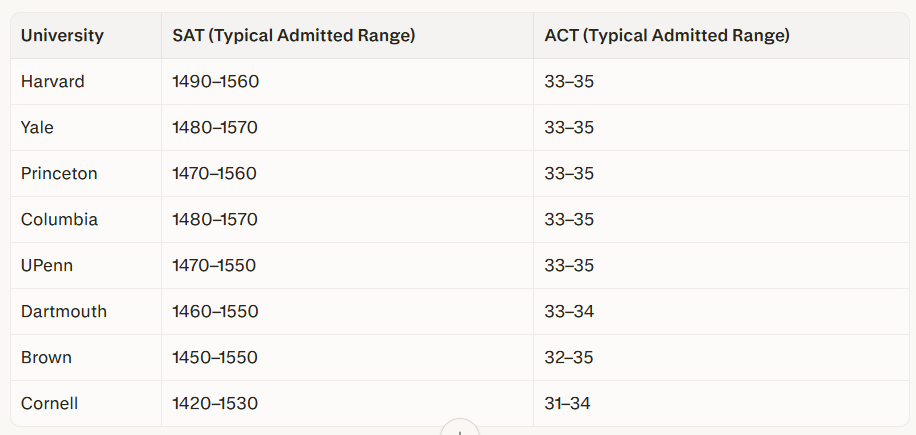
For international applicants, achieving scores at or above the 75th percentile (top 25% of admitted students) substantially strengthens competitiveness, particularly when combined with strong English language proficiency (TOEFL 110+ iBT or IELTS 8.0+).
Holistic Review: Beyond Grades and Test Scores
Ivy League undergraduate admissions is fundamentally not a meritocratic sorting mechanism. Rather, it is a contextual evaluation of who you are, what you've accomplished, and what unique perspectives you bring to the campus community.
The holistic review framework evaluates:
1. Academic Rigor and Context
Admissions officers recognize that not all high schools offer equivalent opportunities. A student from an elite boarding school or international school with IB curriculum is expected to pursue the most rigorous available coursework. A student from a government school in a tier-2 Indian city with limited advanced offerings is evaluated within that context. The question is not "Did you achieve perfection?" but "Did you pursue excellence within your available constraints?"
A 3.95 GPA from a top international school carries different weight than a 3.95 GPA from a rigorous government school, but both can be competitive. What matters is trajectory and demonstrated willingness to challenge yourself. A student with a 3.8 GPA who took advanced courses or pursued independent study, a student who shows significant improvement over time, or a student who maintained strong grades while working 20 hours per week to support family finances demonstrates resilience and self-motivation that test scores cannot reveal.
2. Extracurricular Activities: Depth Over Breadth
The "well-rounded student" is often misunderstood. Ivy League schools do not seek students with superficial involvement in ten clubs. Instead, they seek students with "spike"—demonstrated depth, leadership, and impact in one or two areas that reflect genuine passion.
Examples of high-impact extracurricular positioning:
-
Research or intellectual projects: A student who conducted original scientific research, published findings, or presented at academic conferences demonstrates intellectual initiative and persistence beyond classroom requirements.
-
Leadership with measurable impact: Founding a debate club that grew from 5 to 50 members, leading a community service project that raised funds or improved local conditions, or organizing an academic competition shows agency and impact.
-
Athletic or artistic achievement: Representing your country in a sport, winning a national music competition, or achieving advanced proficiency (3rd grade piano, state-level debate) demonstrates sustained commitment and excellence.
-
Self-directed pursuits: Teaching programming to underprivileged students, creating a blog covering policy issues, learning a language to communicate with a specific community, or starting a social enterprise reflects initiative and values alignment.
The critical evaluation criterion: Can you articulate why this activity matters to you, what you've learned, how you've grown, and what impact you've created? Generic club membership lists signal passive engagement; specific examples of leadership or learning signal genuine involvement.
3. Essays and Personal Narrative: Authenticity Matters
Ivy League essays are designed to reveal who you are beyond grades and activities—your values, thinking, character, and perspective. Common essay prompts across the Common Application ask you to discuss: a meaningful intellectual interest, an identity or background that shapes you, a challenge you've overcome, or how you'll contribute to the campus community.
The most compelling essays share several characteristics:
-
Specificity: Rather than abstract statements ("I'm passionate about social justice"), ground your narrative in concrete examples ("When I watched my mother negotiate with a landlord in Hindi while I translated, I realized language shapes power dynamics in ways that fascinate me").
-
Vulnerability and growth: Share a moment of failure, confusion, or limitation, and explain what you learned. Admissions officers value intellectual humility and growth mindset more than perfection.
-
Distinctive voice: Your essay should sound like you, not like a consultant's template. Use natural language, humor if it's authentic to you, and reveal your perspective.
-
Clear connection to academic or personal mission: The strongest essays connect your background, interests, and values to your reasons for attending the university. If you're passionate about climate science, discuss how Ivy's particular research centers, faculty, or community service opportunities align with your goals.
Weaker essay example: "I am a leader who is passionate about education. I have always been interested in helping others, and I hope to make a positive impact on the world through my community service work."
Stronger essay example: "When I returned to my village after completing 10th standard, I was struck by the absence of my friend Priya—she had dropped out because her family couldn't afford school fees and expected her to marry. I couldn't accept this. I contacted a local NGO and, over 18 months, helped secure scholarships for 12 girls in my community. The process taught me that educational access isn't just about resources; it's about social dynamics, family economics, and advocacy. This experience crystallized my commitment to studying sociology and policy, fields where I can understand and influence systemic barriers. Yale's sociology program—particularly Professor X's research on gender and education in South Asia—aligns directly with this mission."
Recommendations and Application Components
Ivy League applications require school report, transcripts, and 2-3 teacher recommendations. For international applicants:
-
Choose recommenders who know you well: Ideally your strongest teacher in a core subject (math, science, humanities) or an advisor who has supervised independent work. Avoid recommenders who write generic letters.
-
Provide context: Briefly meet with recommenders to discuss your college goals, extracurricular achievements, and specific examples of your intellectual curiosity or leadership. Give them 4+ weeks to write.
-
Counselor report: Your school counselor's report should contextualize your school's resources, your performance within your school's system, and any relevant personal circumstances.
For international students, a supplementary document explaining your school's grading system (if it doesn't use percentage or 4.0 scale) can be helpful. Some international schools use different evaluation systems; a brief clarification ensures fair interpretation.
III. Graduate Admissions: Master's, PhD, and Professional Degrees
Graduate Program Diversity and Application Pathways
Unlike undergraduate admissions, which is centralized at the college level, graduate admissions at Ivies is decentralized: each school, department, or program sets its own requirements and processes. A PhD in Chemistry at Yale follows a different application timeline than a Master's in Public Administration at Harvard. This diversity necessitates that applicants carefully research each program's specific requirements rather than assuming a uniform standard.
Common requirements across most Ivy graduate programs:
-
Bachelor's degree (or equivalent) completed prior to enrollment
-
Official transcripts from all undergraduate and graduate institutions attended
-
GPA: Typically 3.3–3.7 for Master's; 3.5–4.0 for PhD
-
Standardized tests: GRE for most programs (GMAT for MBA, LSAT for Law, MCAT for Medicine)
-
TOEFL or IELTS: 100+ iBT TOEFL or 7.5+ IELTS for non-native English speakers
-
3 Letters of recommendation
-
Statement of Purpose / Personal Statement
-
CV/Resume
-
Application fee ($105–$200 typical)
Program-specific variations: Some programs require GRE subject tests (Chemistry PhD requires GRE Chemistry), writing samples (MFA programs), research proposals (PhD programs), or portfolios (architecture, design)
The Statement of Purpose: The Most Critical Graduate Application Component
While standardized test scores and GPA establish baseline qualifications for graduate programs, the Statement of Purpose (also called "Personal Statement," "Statement of Academic Purpose," or "Research Statement") is often the single most determinative factor in graduate admissions decisions. This document allows admissions committees to assess: (1) clarity of research interests, (2) alignment with the program's faculty and resources, (3) capacity for original thinking, and (4) readiness for graduate-level work.
The typical Statement of Purpose structure:
1. Opening Frame: Your Research Motivation (1–2 paragraphs)
Begin by establishing your research interests and the formative experiences that shaped them. This is not a childhood memoir; rather, it's an explanation of how you became intellectually engaged with your field.
Effective example: "During my undergraduate research in developmental biology, I became fascinated by the mechanisms controlling embryonic pattern formation. Specifically, a summer spent working with zebrafish embryos revealed how subtle variations in morphogen gradients could determine cell fate. This experience crystallized my conviction that understanding development requires integrating molecular biology with computational modeling. I want to pursue a PhD to develop this integration."
2. Program Fit: Why This University, These Faculty (1–2 paragraphs)
Demonstrate that you have researched the program thoroughly and identified specific faculty whose research aligns with your interests. This shows that you're not applying to a generic program but have made an informed, deliberate choice.
Effective example: "Professor X's recent work on morphogen gradient dynamics using machine learning resonates deeply with my interests. Her lab's integration of live imaging, computational modeling, and genetic manipulation mirrors the methodological approach I want to develop. The developmental biology program's emphasis on quantitative approaches, combined with Yale's computational biology cluster, offers the ideal environment for my research trajectory."
3. Qualifications: Your Research Experience (1–3 paragraphs)
Provide specific details about research projects you've led or substantially contributed to. Include: project title, duration, your specific role (not "contributed to" but "designed experiments for," "wrote analysis code for," "led data analysis for"), outcomes, and what you learned.
Effective example: "I conducted a two-year honors thesis investigating estrogen receptor dynamics in breast cancer cells. I designed a series of immunofluorescence experiments to track receptor localization under different hormone concentrations, imaged over 500 cells across 10 experimental conditions, and developed automated image analysis code (Python) to quantify receptor intensity. The project yielded one first-author publication in Journal of Cell Biology, with a second manuscript in revision. Through this work, I became proficient in microscopy, image analysis, and experimental design—competencies critical for my proposed research."
4. Closing: Your Vision Forward (1 paragraph)
Conclude by briefly restating your core research question and how the program will enable you to investigate it.
Effective example: "My PhD research will integrate molecular biology, computational modeling, and developmental embryology to understand how morphogen gradients encode spatial information. Yale's outstanding faculty, research resources, and interdisciplinary culture position me to make meaningful contributions to this frontier."
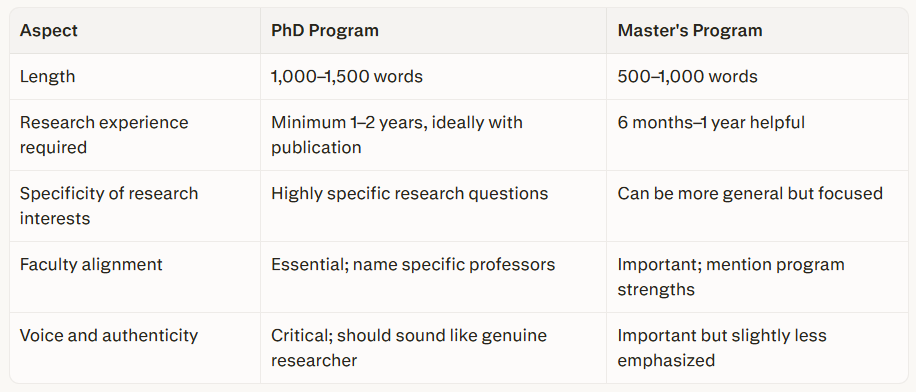
Graduate Statement of Purpose Benchmark:
Common mistakes in Statements of Purpose:
-
Generic language: "I am interested in biology" or "I want to pursue advanced research" without specificity. Instead: "I want to understand how circadian oscillators maintain robustness against genetic and environmental perturbations."
-
Overstating vagueness as flexibility: Don't frame uncertainty as strength. "I'm not sure what I want to study yet, but I'm interested in exploring options" signals you're not ready for graduate-level research.
-
Failing to demonstrate research understanding: Describing project logistics without connecting to larger intellectual problems. Move beyond "I did X experiment" to "This experiment revealed that [specific finding] challenges [existing assumption], suggesting..."
-
Insufficient program specificity: Generic praise ("Your university is excellent") rather than specific engagement ("Your lab's approach to [specific methodology] directly enables my research agenda").
-
Excessive length or wordiness: Use concise language. Admissions committees read hundreds of these; clarity and precision demonstrate intellectual discipline.
Research Experience and Its Centrality to Graduate Admissions
For PhD admissions in STEM fields, research experience is the single most important factor, outweighing even GPA. Admissions committees recognize that GPA measures performance in coursework, but research experience reveals capacity for original thinking, problem-solving under uncertainty, and the ability to design and execute a scientific project.
Research experience hierarchy for competitive PhD applications:
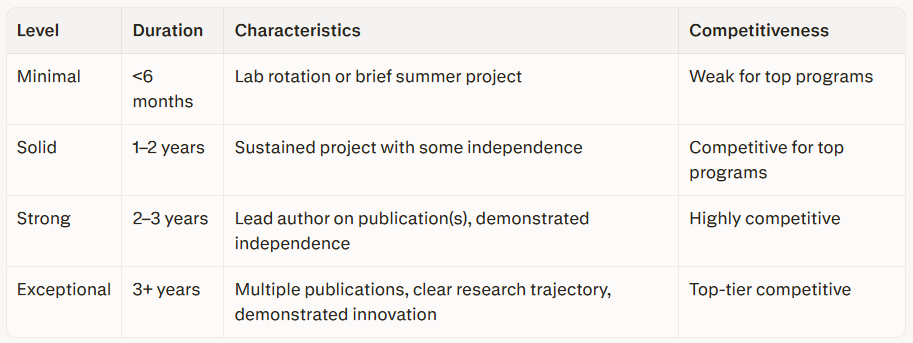
For international students, research experience is particularly valuable as a differentiator. A student from an institution without strong research infrastructure who nonetheless secured a research opportunity and contributed meaningfully demonstrates agency and intellectual initiative—qualities that mitigate concerns about a smaller reputation university.
How to strengthen research credentials:
-
Seek research opportunities early: Many universities offer summer research programs (REUs in the U.S., internships in India/China). Start in your second year if possible.
-
Pursue depth, not breadth: A 2-year engagement with one project and one faculty mentor is more valuable than rotating through four different labs.
-
Develop independence: Move from "following instructions" to "designing experiments" or "solving analytical problems independently."
-
Aim for publication or presentation: A first-author publication, presentation at a conference, or even submission to a journal demonstrates research maturity.
-
Build strong relationships with faculty: A detailed, specific recommendation letter from a research advisor carries enormous weight. Meet regularly with your PI, discuss research directions, and show genuine intellectual engagement.
GPA and Test Scores: Necessary But Insufficient
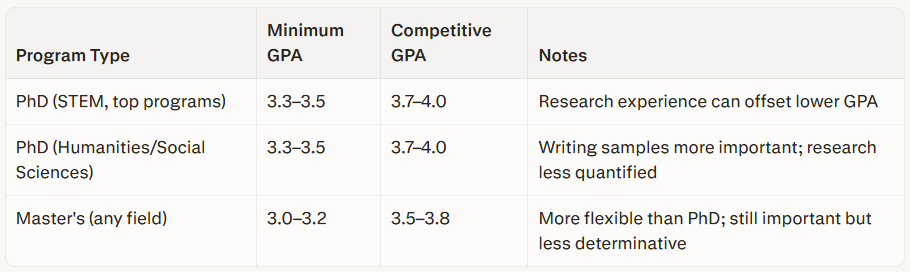
Graduate programs use GPA and test scores as screening mechanisms. A GPA below 3.3 or GRE scores below the 50th percentile may disqualify applications before they receive holistic review. However, once you clear this threshold, GPA becomes less determinative than research experience, letters of recommendation, and Statement of Purpose.
GPA guidance by program type:
GRE guidance:
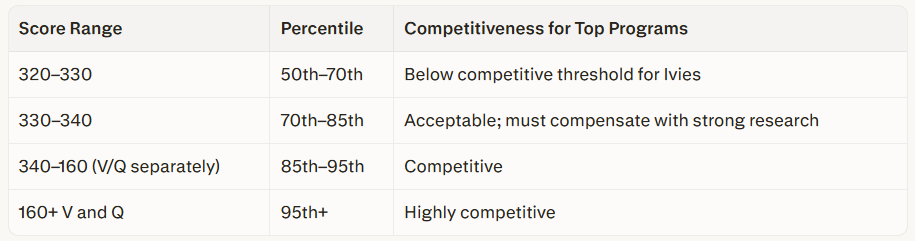
For international students with non-English backgrounds, TOEFL or IELTS scores are mandatory (even if your undergraduate degree was taught in English). Scores should be 100+ iBT TOEFL or 7.5+ IELTS to remain competitive.
Letters of Recommendation for Graduate Programs
Graduate programs require 3 letters, typically from faculty who supervised your research, taught advanced courses, or supervised projects. The quality and specificity of these letters matter enormously.
Strong recommendation letter characteristics:
-
Written by someone who supervised your research directly (far more valuable than a famous professor who taught you in a large lecture)
-
Provides specific examples: "During the protein folding project, she independently designed a series of mutations to test the hypothesis, wrote Python code to analyze results, and revised the manuscript draft three times with increasing sophistication."
-
Addresses intellectual qualities: creativity, rigor, perseverance, capacity to learn from failure
-
Demonstrates knowledge of your ambitions and alignment with them
-
Avoids generic praise; every sentence tells an admissions committee something substantive about your potential as a researcher
Common mistakes:
-
Asking a famous professor who taught you in a large class but has no direct knowledge of your work
-
Failing to provide recommenders with your CV, Statement of Purpose, and a brief reminder of key projects you worked on together
-
Not giving recommenders sufficient time (minimum 4 weeks)
-
Allowing recommenders to submit without knowing what they'll write
IV. Cost, Financial Aid, and ROI: International Student Considerations
Undergraduate Costs: The Sticker Price and Actual Cost
Ivy League undergraduate tuition ranges from approximately $56,000–$72,000 annually, with total cost of attendance (including room, board, books, and personal expenses) reaching $86,000–$95,000 per year.
Full Undergraduate Cost Breakdown (2025–2026):
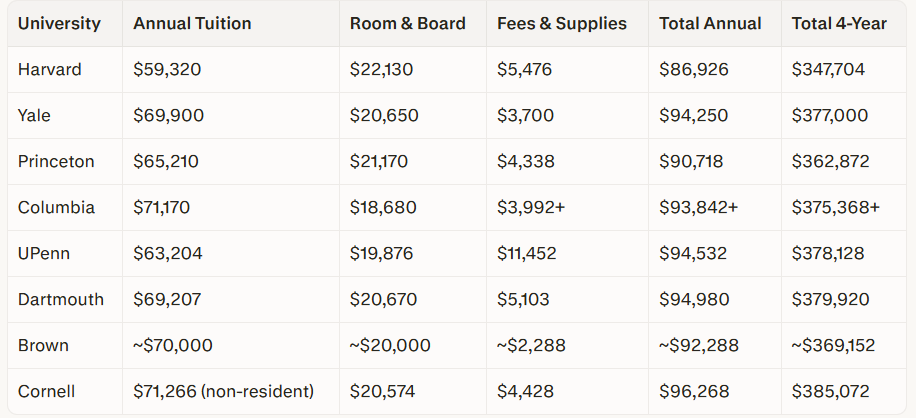
Key insight: Cornell and Dartmouth are exceptional among Ivies in offering full financial aid to all admitted international students. For international students from lower-income backgrounds, these two schools represent meaningfully more accessible pathways.
Financial aid examples:
A student from India with a family income of $50,000 USD admitted to Harvard might receive a package covering full tuition and 50% of living expenses (~$55,000 annually), requiring family contribution of ~$32,000. A student from a wealthy family might receive no financial aid despite admission.
Graduate Program Funding: Substantial Differences from Undergrad
Graduate funding is vastly more generous than undergraduate funding, particularly for PhD programs.
PhD Funding at Ivies:
Most Ivy League PhD programs offer full funding to all admitted students, including:
-
Full tuition coverage
-
Annual stipend ($25,000–$35,000 for most disciplines; higher in STEM fields)
-
Health insurance
-
Research support (conference travel, materials, computing)
This full-funding model is standard across U.S. research universities. If a PhD program doesn't offer full funding, it's not a competitive program. A PhD should cost the student nothing and provide living expenses.
Master's Funding at Ivies:
Master's programs are far less generous. Some fully-funded Master's positions exist (particularly in STEM fields or specialized programs like public health), but many students pay substantial tuition. Funding percentages vary dramatically:
-
Harvard: Many Master's programs require substantial student payment; limited scholarships available
-
Yale: Some programs offer tuition coverage; others require substantial student payment
-
Columbia: Most Master's programs charge full tuition; limited scholarships
-
UPenn: Mixed; some programs (Engineering, Public Health) more generous; others not
-
Cornell: Generally more generous to Master's students than other Ivies
For Master's students from outside the U.S., scholarship funds are extremely limited. Most international Master's students either: (1) self-fund, (2) secure funding from home government or employer, (3) work part-time (if permitted by visa), or (4) seek external fellowships (Fulbright, Chevening, etc.).
V. Application Strategy for International Students: Visa Dynamics and Career Pathways
Visa Sponsorship and Post-Graduation Employment
International students' graduate and undergraduate experiences are substantially shaped by visa dynamics. Work visa sponsorship—particularly H-1B sponsorship for postgraduate employment—has become increasingly uncertain due to policy changes and lottery competition.
Current landscape (2025–2026):
-
STEM OPT advantage: STEM graduates can work in the U.S. for up to 3 years post-graduation through Optional Practical Training (OPT) without requiring H-1B sponsorship. This extended period allows time to secure H-1B sponsorship or establish alternative career pathways.
-
H-1B sponsorship uncertainty: The H-1B visa lottery remains highly competitive. Only approximately 15–20% of applicants are selected in the annual lottery. Large technology firms (Google, Microsoft, Apple) and management consulting firms (McKinsey, BCG, Bain) sponsor H-1B visas routinely, but smaller companies may hesitate.
-
International employment alternative: Many international students plan to return home post-graduation, leveraging the credential and professional networks gained. An Ivy League master's or PhD substantially improves career prospects in India, Singapore, Hong Kong, and other home markets.
For international undergraduate students: U.S. work visa pathways post-graduation are complex and uncertain. However, Ivy League undergraduates have substantially stronger visa sponsorship prospects through recruitment into consulting, finance, and technology roles that regularly sponsor H-1B visas. Additionally, many seek graduate school immediately post-graduation in the U.S., which provides continued visa sponsorship through student visa.
Career Outcomes for International Students
International students face documented challenges in the U.S. job market post-graduation:
-
Internship access: Only 25% of international students complete off-campus internships, compared to 42% of domestic students. This gap reflects visa work authorization limitations and employer hesitance to navigate international student hiring complexity.
-
Job offer conversion: International students are 30% less likely to receive job offers from internship employers, partly due to visa sponsorship concerns.
-
Post-graduation employment rates: 44.6% of international students secure employment within 6 months of graduation, compared to 62.1% of domestic students. However, this gap narrows substantially for STEM graduates and for those attending prestigious institutions.
-
Starting salaries: International students earn higher average starting salaries ($80,785 vs. $70,000+), but this reflects concentration in high-paying STEM and finance roles rather than preference for international hires.
Strategic Guidance for International Applicants
1. STEM vs. Non-STEM Considerations
STEM fields (engineering, computer science, chemistry, biology, mathematics, physics) offer substantially clearer visa pathways post-graduation through the STEM OPT extension. Non-STEM fields (humanities, social sciences, business, arts) face tighter post-graduation employment constraints.
If your goal is to work in the U.S. post-graduation, STEM fields are strategically advantageous. If your plan is to return home or pursue further education (graduate school), non-STEM fields are equally viable.
2. Application Narrative for International Candidates
Your international identity should be framed as a distinctive perspective and asset, not as a liability requiring justification. Effective applications articulate:
-
Why the U.S. education specifically: What distinctive value does an Ivy League education provide relative to top universities in your home country? Strong answers reference specific programs, faculty, research opportunities, or networks unavailable at home.
-
Post-graduation intentions: Be honest. If you intend to return home, articulate how the Ivy credential and networks will enable leadership roles there. If you intend to pursue U.S. employment or further graduate education, articulate your strategy.
-
English language proficiency: For non-native English speakers, strong TOEFL/IELTS scores are table-stakes. Ivies require TOEFL 100+ iBT or IELTS 7.5+ for international applicants. Any score below these thresholds is disqualifying.
3. Application Timeline Considerations
International students face additional application complexity: visa processing timelines, transcripts from non-U.S. institutions, and financial documentation requirements. Strategies:
-
Start early: Initiate GMAT/GRE preparation 6+ months before application deadlines to allow time for retakes.
-
Secure financial documentation immediately: Gather bank statements, tax documents, and employment letters early. Financial verification can delay admissions if documentation is inadequate.
-
Plan for visa processing: U.S. student visa (F-1) processing takes 2–8 weeks depending on country. Apply immediately upon admission.
VI. Common Application Mistakes and How to Avoid Them
Mistake 1: Submitting SAT/ACT Scores Below Competitive Range
International students sometimes apply with scores they consider "reasonable" (e.g., SAT 1300) without understanding that Ivy League medians exceed 1500. Bottom 25th percentile for Harvard is still 1490—nearly 200 points higher. If your scores are below the 75th percentile, invest 3–6 months in preparation and retake, or carefully reconsider program fit.
Mistake 2: Overlooking Test Requirements
Several Ivies have shifted back to test-required (Harvard, Yale, Dartmouth, UPenn, Brown). Columbia and Princeton remain test-optional, but "optional" doesn't mean "won't help." Strong scores provide meaningful advantage at test-optional schools.
Mistake 3: Generic Essays Without Distinctive Voice or Specificity
Admissions officers read thousands of essays. "I want to help people" or "I'm passionate about science" without concrete examples doesn't differentiate. Strong essays are vivid, specific, and reveal your distinctive perspective.
Mistake 4: Weak Recommendations
Recommendations from teachers who write generic praise or lack direct knowledge of your work provide minimal value. Instead, provide detailed guidance to recommenders and ensure they've supervised your work substantively.
Mistake 5: Insufficient Research into Program-Specific Requirements
Graduate programs have diverse requirements. A master's program might require no standardized test; a PhD program might require a subject test. Failing to identify program-specific requirements can result in incomplete applications.
Mistake 6: Treating Statement of Purpose Like a Resume
Your SOP shouldn't list every research project or course. Instead, it should tell a coherent narrative of intellectual development, show clear alignment with program faculty, and demonstrate genuine research passion.
VII. Future Trends: The Evolving Admissions Landscape
Test-Optional Policies Continuing to Shift: Most Ivies have returned to test-required status. Expect this trend to continue; test scores remain important for demonstrating academic capability.
AI Integration in Admissions: Some Ivies are piloting AI-assisted application screening to identify strong candidates and flag red flags (inconsistencies, potential plagiarism). The strategic implication: ensure your application is authentic and internally consistent.
Diversity Initiatives Evolving: Post-Supreme Court decision on affirmative action, Ivy League schools are shifting emphasis from race-based preferences to recruitment of underrepresented geographies and socioeconomic backgrounds. International students from rural or economically disadvantaged areas increasingly represent institutional diversity priorities.
International Student Recruitment Moderating: Several Ivies have seen slight declines in international applications due to visa uncertainty and growth of strong domestic alternatives. This may slightly increase relative acceptance rates for international students, though remains highly competitive.
Conclusion: Your Ivy League Application Strategy
Gaining admission to an Ivy League institution—whether undergraduate or graduate—requires excellence across multiple dimensions: strong academics, compelling essays, demonstrated impact, and clear alignment with institutional values. For international students, additional factors matter: visa clarity, authentic engagement with the institution, and strategic consideration of post-graduation pathways.
The most successful applicants begin early, invest in preparation, and approach each element of the application with authenticity and strategic intentionality. An Ivy League education remains among the world's most transformative; the admissions process, while intensely competitive, is designed to identify talent and potential, not merely perfect credentials.